fbpx
Pardon our dust! We are in the middle of a website redesign.

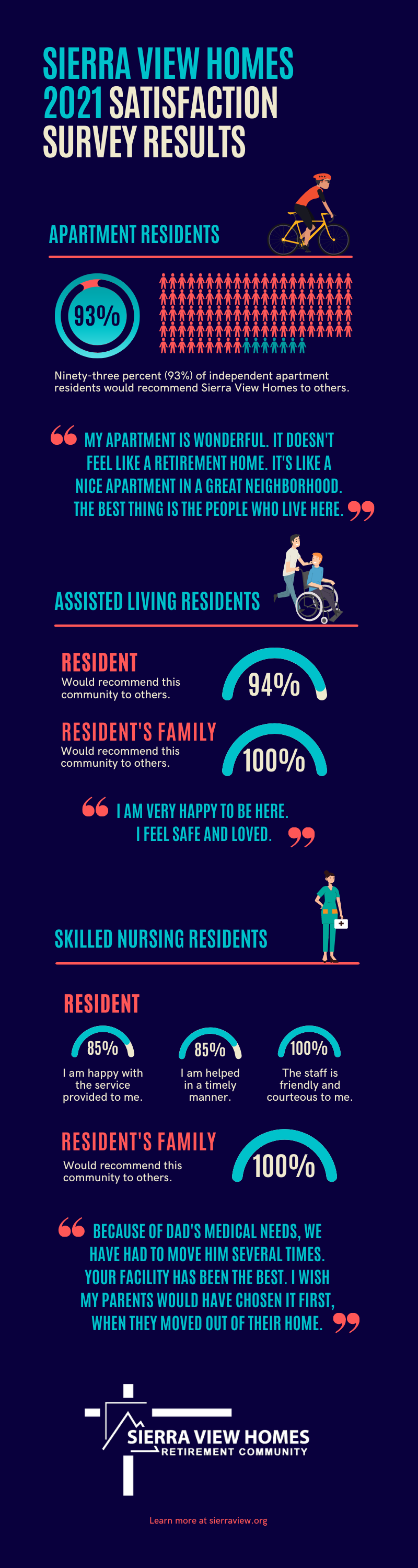
Infographic: Sierra View Homes Satisfaction Survey Results

Sierra View Homes Retirement Community sent out our resident satisfaction surveys during the summer. The questionnaire was either completed by mail or by individual interview. Of course, we are looking for a “report card” to see how we measure up, but we are also trying to understand if some areas need to be worked on.

We are pleased to report that our scores were high for each of the service lines! Certainly we want to improve all the time. Of the questions, we pulled from the ones that capture the resident’s full impression of our services. Full details may be found in the office, but we would like to summarize here for each service line:

Independent Living: 94% of residents see Sierra View Home’s apartments as a good value for the money, and 93% would recommend our community to others. A few of you would like to see more variety on the food menu and an increase in maintenance helpers.

Assisted Living: 100% of the residents and family members are “happy with the care and service that is provided.” A few of you would like to see more group activities in the evenings and weekends. 100% would recommend Sierra View Homes to others.

Skilled Care: More than 85% of residents and family members are happy with the care and service that is provided and 100% of the family would recommend Sierra View Homes to others. Some of you want more choice and participation in making decisions about their care and routines.

We appreciate your support and encouragement, especially after a very difficult year and a half. You also have given us some areas to improve on, and we will be working on them with expediency and diligence.

Get Moving During the Day, Sleep at Night

There is a link between the activities you do during the day, the food you eat and the calming techniques you have, to the amount of sound sleep. Sierra View Homes‘ new “Get Moving Program” teaches the important aspect of good sleep. Sleep helps repair damage, clears the debris in the brain, and enhances healthy aging. Actions in the brain while we sleep is a process of taking out the trash and repairing damage that can lead to serious illness. Nearly all brain repair occurs during sleep. Unfortunately, many older adults often get less sleep than they need. Falling asleep is a frequent complaint. Studies show that we all should get eight hours of sleep each night no matter what age we are. This amount of sleep allows our bodies to feel rested and our minds to be more fully alert during the day. Since many of us are not able to get a full night’s rest, we have a very good excuse for being irritable, tired and forgetful during the day.

Researchers are finding that our sleep pattern changes throughout our adult life span. Our sleep at age 70 is not as sound as a 20-year old. As we age, our bodies and our health also change and we tend to have more issues that can disrupt sleep. Older individuals tend to get sleepy earlier in the evening and dozing in the evening can lead to trouble falling asleep when it is time to go to bed for the night. Drinking alcohol and caffeine, as well as smoking in the later part of the day, can trigger sleep problems. Sleep disturbances happen mostly because of illnesses or the medications used to treat them. It makes sense that the more disorders one has, the harder it is to get a good night’s sleep.

Pain is a common cause of disrupted sleep. It can keep one from falling asleep or be the thing that wakes you up in the night. Not sleeping well during the night can lead to increased pain the next day. Lack of sleep keeps us from dealing well with pain issues.

Some medical issues come with medications that cause sleep problems. Many medications have stimulating effects that can keep you from falling asleep. Diuretics, for example, when used to treat water retention, causes repeated periods of waking up to go to the bathroom.

Sleep Apnea is a source of sleeping difficulty. People with sleep apnea tend to snore loudly, stop breathing for 10-30 seconds and then start breathing with a gasp. This routine can happen repeatedly throughout the night. Each time the breathing starts again the person wakes up for a little while. Sleep apnea can cause daytime sleepiness and cause high blood pressure and heart disease to worsen. It can be treated with some lifestyle changes or with the “continuous positive airway pressure” CPAP machine. Sometimes surgery can help, but it is important to talk to your doctor if you are experiencing these problems.

Another issue that can keep people awake is Restless Leg Syndrome. People who have a creepy-crawly feeling especially in the legs could be experiencing Restless Leg Syndrome. This feeling makes you want to move around. It tends to get worse in the evenings as your body is starting to relax for sleep. You could also have Periodic Limb Movement Disorder. A person with this disorder kicks one or both legs many times during sleep. Treatment that could help for these disorders is taking a hot, or cold bath,

placing hot, or cold packs on your legs, relaxation techniques or massaging the legs and feet.

If daytime sleepiness becomes excessive it may be time to talk to your doctor. Your doctor will try to pinpoint what is keeping you from a good night’s sleep. He/she may prescribe medication to help you get back into a routine for a good night’s sleep. The doctor may prescribe sleep aides to help you get to sleep. It is important to remember that those sleep aides can prove to be addicting and cause a worse problem in the end. Be sure to work with your doctor following directions regarding the sleep aides.

Getting adequate sleep requires both sufficient total sleep time and enough deep sleep. It is important to be mindful of what keeps us from getting that sleep. Establishing a bedtime routine that includes relaxation and going to bed at the same time every night, avoid drinking alcohol and caffeine in the late afternoon and doing some exercise every day helps one fall asleep more easily. Taking naps more than 20 minutes in length or dozing in the evening may keep you from falling asleep easily. Keep a diary of your sleep habits to determine if there are lifestyle changes you could make to improve your quality of sleep.

So, remember your childhood – a time when you did not have health issues, stress or interruptions that kept you from getting a good night’s rest. We all need to have a good night in order to have a great day. Chronic lack of sleep increases the risk of health problems, so if you are having trouble sleeping, I encourage you to keep a diary, adjust your routine to encourage sleep, and see your doctor if you have excessive sleepiness during the day. A good night’s sleep brings great days, good health and successful aging so it pays to take the time to assess your sleep habits to have a good night’s sleep.

Chaplain’s Corner: Do Not Let Your Regret Define You

We all have regrets. The thoughts of what we “should have” done instead of what we did, often nibbling at the corners of our minds as we fall asleep at night or when we find ourselves in a reflective mood. Joan Chittister, in her book The Gift of Years, speaks of the two faces of regrets: the regret of our failures, and the regret of our life choices.

Regretting our failures is a painful thing, but it also is a sign of growth. Whether it is injury we have caused to ourselves or to others, realizing this harm is a reminder that we have grown and matured. If the circumstances presented themselves again, we would choose differently, because we are no longer the person we used to be.

Regretting our life choices is just as common, but not as healthy. Chittister writes that this type of regret is a temptation that “entices us to lust for what never was in the past rather than to bring new energy to our changing present.” There are many ways to fullness in life, all of them different, all of them unique. To regret the paths we did not choose is to miss the gratitude for the path we have chosen.

Paul functions as a good model for this. Formerly a persecutor of Christians, Paul, through his growth in Christ is able to acknowledge the regrets of his failures from earlier in life. And yet, he does not let these life choices define him. In Phillipians 3:13-14 he writes:

“Brothers and sisters, I do not consider myself yet to have taken hold of it. But one thing I do: Forgetting what is behind and straining toward what is ahead, I press on toward the goal to win the prize for which God has called me heavenward in Christ Jesus.”

Let us allow our regrets to remind us of the people we have become while resisting the temptation to let them hold us back from the people Christ is calling us to be.
– Caley Ortman, Sierra View Homes Chaplain

Chaplain’s Corner: Unboxing our Faith

It seems to be a fairly universal human trait to want to know exactly what goes in each box. We have a work box, we have a family box, we have a faith box and so on. This pandemic year has turned our boxes upside down into one pile in the middle of the floor and the experience has been overwhelming to say the least.

The box we guard most closely and tend to be most protective of however, is our faith box. We like things a certain way and we like them predictable. There has been nothing predictable about church this last year, which has ranged from distanced indoors with masks, to drive-in, to pre-recorded, to Zoom from the couch, to no church service at all.

It has been a year of frustration, but also a year of stretching, and as it turns out, sometimes in stretching we find new growth. We have become more creative in finding meaningful ways to sing, worship and fellowship from digital spaces. We have involved the gifts of more people instead of leaning only on one pastor. We have supplemented our Sundays with intentional spiritual practices during the week, leaning on friendships and taking advantage of the quiet spaces that isolation has given us. We have lived into the phrase “the building is closed but the church is open.”

Pastor Meghan Good, in an article called Taking Jesus Out of Your Box, brings to our attention our tendency to “become wedded to the vessel instead of the thing it was made to contain.” She writes: “We see God somewhere, build a box around it, and celebrate the divine capture, never noticing that God is standing behind us, tapping on our shoulder.”

All of us are looking forward to the day when we can return to our sacred spaces, embrace each other without fear and sing praises to God without masks. And hopefully when we do, we remember the ways we have been stretched. May we be willing to shed some of the of the old that has perhaps been holding us back, and embrace some of the new that surprised us with meaning during our pandemic worship. May our boxes of faith serve to hold, but not to contain the wild and living God that is always revealing to us something new.

Chaplain’s Corner: Struck Down But Not Destroyed

As this year wraps up not many of us are sad to see it go. It has been a year none of us anticipated a year ago when we excitedly watched the ball drop on New Years Eve. COVID has cast a shadow on almost every part of our lives this year, from our health, to our relationships, to our finances to our politics.

Entering a new year we find ourselves unsure of how to feel. Glued to the news cycle we are continually warned that the worst is always still coming and that we are left to helplessly watch as the country and the economy circle the drain. On the other side of things we hear a giddy optimism that seems to promise that as soon as the clock strikes 2021 all of this will be over and we can go back to exactly the way things were. So which one is it? Which one do we pick?

Another way may in fact be neither! The apostle Paul had a way of navigating through the waters of fatalistic pessimism and naive optimism and presenting a third way that was both realistic and hopeful. In his correspondence with believers in Corinth he writes:

“We are hard pressed on every side, but not crushed; perplexed, but not in despair; persecuted, but not abandoned; struck down, but not destroyed. We always carry around in our body the death of Jesus, so that the life of Jesus may also be revealed in our body. (2 Cor .4:8-10)

Paul knew the pain and hardship of trying to hold together the early church in all of their squabbles and misunderstandings. He lived his life with the oppression of empire that was a continual threat to his life. But he also knew what it was to know Christ, and to know that there was nothing in this world that could separate him (or us) from that kind of hope and love.

As we enter 2021 let us take on the posture of Paul, preparing ourselves for the challenges yet to come, while refusing to be consumed by them. Let us look back at the ways 2020 made us stronger and continue forward as a community of faith that has known the love and hope of Christ, carrying that life in our bodies, bringing light into the darkness.

Chaplain’s Corner: Advent – Waiting Out the Darkness

Our society’s transition from Thanksgiving to Christmas can be quite jarring. As soon as the dishes are done from the Thanksgiving meal we are hit by the blitz of advertising reminding us that there is no better time to buy Christmas gifts. Yard reindeer go up, retail stores cycle through their Christmas playlists, and every movie and commercial on TV seems to end with smiling families in matching sweaters around a Christmas tree.

But are we getting ahead of ourselves a bit? In the Christian calendar, the end of our Thanksgiving holiday also marks the start of Advent. It is not a season marked with jubilant celebration (that will come), but rather of waiting and anticipation.

It is a time to read the Old Testament prophets and to remember how long Israel cried out for a messiah during their years in captivity and exile. It is a willingness to set aside “It’s the Most Wonderful Time of the Year” and join the haunting prayer of “O come O come Emmanuel and ransom captive Israel.”

In Assisted Living we have set up an Advent wreath. Every Friday we will light a candle and read the designated scriptures. The four candles around the wreath represent hope, love, joy and peace. On Christmas day we will light the Christ candle in the center to celebrate Jesus entering our world and forever changing us.

We are living through a dark time of our own. We wait for a vaccine, we wait for political and economic stability, we wait for the day we can give hugs without the burden of fear and uncertainty. The waiting of Advent is not a passive task, sitting around distracting ourselves with wishful thinking. It is an active posture, in which we join with determination and hope, believing that God hears our cries, God cares and God saves.

Wherever you are this season, join us in lighting a candle every week and remember that “a light shines in the darkness and the darkness has not overcome it.” (John 1:5)
– Caley Ortman, Chaplain

Chaplain’s Corner: Pyramid Schemes


Our culture has an unhealthy view of aging. We draw the trajectory like a pyramid. Everything is looking up until midlife, and then it is all downhill from there. It is no wonder we are conditioned to see life like this, considering our disproportionate value on sexuality and productivity. But scripture paints a different picture.

The psalms talk of flourishing in old age. Not the kind of flourishing that comes with competitive athletics and managing a financial empire, but one that is steeped in the wisdom that can be nurtured through knowledge and life experience.

Scripture abounds with stories of God calling people late in life. Much later than even the individuals themselves expected! Our vitality and service to others continues until we are called home, sometimes in ways we are used to and sometimes in entirely new ways.

Richard Morgan tells this story: “A tourist, tramping about in the villages of New England, came upon an old woman sitting in silence on the front porch of her cabin. The tourist asked, ‘Lived here all your life?’ She replied, ‘Not yet.’ That is the spirit of the older person who lives every day with joy and expectation.” Reject the pyramid and embrace the endless possibilities of God.
– Caley Ortman, Chaplain

Chaplain’s Corner: Amazing Grace

I have always loved how the Bible informs us of its heroes’ shortcomings right alongside their heroic feats without batting an eye. I was reminded of this again as we have worked our way through the story of Moses in our weekly Chats with the Chaplain. When Moses stumbles upon the burning bush he is watching over sheep for his father-in-law. Why? Because fourteen verses earlier he fled for his life after he had killed a man! Certainly, if anyone should ever be disqualified from leading God’s chosen people, it should be Moses.

This is not an isolated incident. God works like this all the time. Jacob cheated his brother out of his inheritance. Peter denied Jesus. Paul’s first line of work was killing Christians. God sees the potential in people long after society and even the individuals themselves stop seeing it.

We are our own worst enemy in this regard. We keep a tally of all the small ways we have fallen short, counting ourselves out of the running for qualifying as “worthy,” and spending anxious nights staring at the ceiling, wondering if perhaps our best wasn’t good enough for God after all.

Grace is a difficult concept to grasp. It takes faith to believe that God could see something that we can’t. To believe that however much we fall short by, God can make up the difference. Kathleen Norris writes that “God loves to look at us, and loves it when we will look back at him.” How beautifully simple the love of God and how complex we make it. Norris concludes that one reason we worship is to respond to God’s grace, praising God not to celebrate our own faith but to give thanks to the faith God has in us.

May we have the faith and the assurance that it is so.
– Caley Ortman, Chaplain

11 Tips for Surviving (and Thriving) in Isolation

As the pandemic marches into its sixth month, with no end in sight, the forced isolation it brings has started to take its toll. While shelter-in-place orders result in some of us sheltering with family or roommates, others of us end up sheltering alone. 

The psychological difficulty posed by isolation and loneliness is well-documented. Thus, while safeguarding our physical health and fighting the spread of COVID-19 in our community is critical, it is equally important to take active steps to safeguard our psychological health while isolating.

Here are a few ideas for behaviors that can help you thrive during this time:

  1. Learn (or share) a skill.
    Learn a new language (try the free Duolingo app). Educate yourself about the world on Wikipedia. Check out courses on Skillshare, Masterclass, or Udemy. Follow tutorials on YouTube. This is a great time to learn something new! Or do you have expertise in an area? Maybe it’s time to share it!
  2. Listen to podcasts.
    Podcasts often involve groups of people having long-form conversations, and listening can feel like being part of the conversation. Choose several podcasts about topics that interest you, and listen routinely. Make sure you choose positive, uplifting podcasts to incorporate into your day. Download Apple Podcasts on your iPhone or the Podbean app on your Android phone, and start searching for topics that interest you. Here are a few fun options:
    • Wait, Wait, Don’t Tell Me – NPR humor podcast about the week’s news.
    • Short Wave – A daily science podcast.
    • Conan O’Brien Needs a Friend – Conan interviewing celebrities.
    • The Story Geeks – Discussions of science fiction, fantasy and comic book movies.
    • Hidden Brain – Audio essays on why we do the things we do.
  3. Pick up the phone.
    Our culture has gotten out of the habit of talking on the phone, often favoring text messages, emails, and social media interaction. However, none of these options offer the same level of social connection as hearing another person’s voice. Until this pandemic is under control, it’s time to dust off the old-fashioned social phone call! 
    • Don’t have anything new to talk to your friends and family about? Check out the game “Vertellis”, which offers “conversation cards designed to get you past small talk and have genuine conversations.”
    • Make a list of the people you care about. Call and verbally connect with one person per day.
  1. Video messaging.
    WhatsApp, Zoom, Facetime, and Google Hangouts all offer video chatting options. Also check out Marco Polo, a messaging app that allows you to record and send video messages to your loved ones that they can respond to at their leisure. It’s great for connecting with friends or family in different time zones and keeping connected with others in a way that fits into their schedule, without the time pressure of coordinating a phone call.
  1. Use this time to recover.
    Do you have hurts, hangups, or habits that get between you and God, or between you and other people? Are you struggling with anger, codependency, anxiety, or past abuse? This is a great time to work on yourself.
    • Consider Celebrate Recovery: Many branches of Celebrate Recovery are open and helping people over Zoom. Here in Reedley, Celebrate Recovery meets on Monday nights at https://redeemerscr.online.church/ at 6:30 p.m.
    • Connect with a Counselor: Connect with a counselor for online therapy sessions. https://www.betterhelp.com/
    • If you need someone to talk to 24/7, there are resources here: https://idontmind.com/findhelp
      – NATIONAL SUICIDE PREVENTION LIFELINE – 1-800-273-TALK
      – CRISIS TEXT LINE – Text IDM to 741741
  1. Record your life experiences.
    This is a time to take a break from busyness and reflect. You have hard-won wisdom and memories. Use this time to record them!
  2. Adopt a pet.
    This might be a great time to adopt a dog or cat from a local shelter! The benefits of pet ownership for happiness levels are well-documented.
  3. Limit social media and news.
    Increased time on social media and partisan news consumption are positively correlated to unhappiness. Replace the illusion of connection over social media with actual phone calls. Choose news sources that provide balanced media coverage, and limit your time on them.
  1. Write letters and cards.
    Letter-writing is another long-dormant habit that it’s time to dust off. If you take the time to write letters of appreciation to the people in your life, they could become treasured keepsakes, while keeping you focused on the positive.
  2. Count your blessings.
    Every day, take time to record blessings in your life! Then go back and re-read your list frequently.
  1. Get creative.
    Create something. Write short stories, pull out those paints, tackle that novel. Now is the time to do it!

Isolation does not have to be negative. If we take some of these intentional steps, we might just come out of the pandemic stronger than ever.

How to Combat Loneliness in Older Adults

This article was written before the COVID-19 pandemic hit. Check out our new article for 11 more tips on how to survive – and thrive – during periods of isolation!

Loneliness and social isolation are a huge concern for older adults. As we age, it becomes harder to stay connected with family and friends, especially if you are living alone. Older adults face loss, loss of a good friend or spouse to illness or death. They have to face issues such as hearing and or vision loss, mobility challenges both physically or in loss of driving privileges. All these issues cause challenges in staying connected. The National Poll on Healthy Aging found one in three older adults say they lack regular companionship and a survey conducted by GreatCall reports 52% of older adults experience feelings of loneliness a few times a year.

Now studies are showing that being lonely can lead to depression and or cognitive decline. They are saying, “Loneliness is as unhealthy as smoking 15 cigarettes per day.” Social isolation and loneliness have been linked to poorer health outcomes and higher healthcare cost. According to AARP this is adding $6.7 billion in health related spending in the older adult population.

Social separation of our families is very prevalent in the United States because our families have spread all over the states and beyond. We are not as connected as we were years ago when generations lived under the same roof. We now have to be more deliberate in staying connected. Thankfully, technology such as Skype, FaceTime, texting and calling have helped to give us connectivity.

There are ways you, as an older adult, could combat loneliness and isolation. You cannot rely on others to combat your loneliness. You need to take matters into your own hands. So, find something to do. Doing something that keeps you thinking about something other than yourself helps to decrease the feeling of loneliness. If you are mobile, join a friend for coffee. I know of several coffee groups meeting in Reedley. I am sure every town has a gathering spot where folks come to meet and connect. Going for a walk or doing some gardening, if you want to stay close to home, gives you some exercise and allows you to breathe deeply. Doing something that is useful and improves the world around you goes a long way to feeling fulfilled and useful.

Take care of yourself. Get your vision and hearing checked regularly. You can be in a room filled with wonderful people but if you do not hear what is being said or you cannot see who is in the room it can be very disturbing leading you to pull back and stay away.

Find a friend to hang out with or do some volunteer work. Look around your community. There are a number of volunteer possibilities. Being in a group working towards a common goal leads to a feeling of inclusion. It is likely you will find someone who is willing to strike up a conversation. Listen, smile and share your thoughts in a give and take conversation.

Consider moving to a retirement community like Sierra View Homes Retirement Community since it offers activities that give opportunities to relate to others. There are dining opportunities that give you a healthy way to be connected. If you tend to be quiet and shy, in a retirement living space there will be plenty of others who will draw you into the conversation. Exercise rooms to encourage you to be active and stay fit.

Travel somewhere new. There are numerous tour groups to join if you are able to travel. There are many places to see near and far. Being curious about exploring some place you have not seen before gives you a way to keep looking forward. It keeps your mind focused on something other than yourself.