Small 'c' Chaplain
Whenever I say or write “Chaplain Len,” I add a little silent prayer that people wouldn’t be too focused on the capital C. I’ve never been big on titles, although I was fascinated to learn the story behind mine, and now I want people to know we have all kinds of “small-c” chaplains at Sierra View.
The roots go back to the third century, and a Roman soldier named Martin, who was traveling in what is now France. He came across a hungry, cold, and almost naked man. Martin took off his military cloak, cut off half of it, and gave it to the man. Later, Martin had a dream where he saw Jesus wearing that piece of the cloak, and the image burned deep inside him.
St. Martin and the Beggar (1597)
Martin went on to become a leader in the early church, and even though he was so humble he would have cringed at the thought, his half-cloak became so treasured it was preserved in a sanctuary. The Latin word for cloak was cappa, and that little sanctuary became known as a cappella (which gave us the word chapel). The person entrusted with caring for it was a cappellanus, and that eventually gave us chaplain.
I have the title of “Chaplain” at Sierra View, but everywhere you turn, you can see small-c chaplains tenderly taking time to meet a wide variety of needs—from physical or practical to relational, emotional and spiritual. The word came through someone who saw a need and did what he could to meet it—and 1,700 years later, it is still about helping people see Jesus.
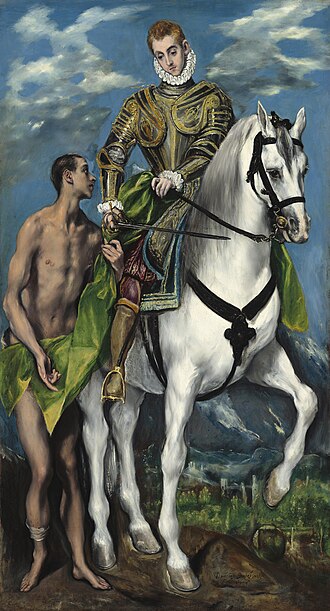
Saint Martin and the Beggar (El Greco), a painting by the Greek mannerist painter El Greco, painted c. 1597–1599.