
“It is said of God that no one can behold his face and live. I always thought this meant that no one could see his splendor and live. A friend said perhaps it means that no one could see his sorrow and live. Or perhaps his sorrow is his splendor.”
This quote by Nicholas Wolterstorff has come back to me as news reports have come out of Israel, each overwhelming and unimaginable in their horror. Images of mourning parents and dust-covered crying children. A fragile peace decimated in a matter of days in one of the most significant holy places on earth. So many innocent lives changed forever on account of the violent actions of a few. How can this happen? Where is God in this?
“How long O Lord?” This is not a new question. It appears often in scripture, most often on the lips of the psalmists and prophets. It is a question born out of an expectation that the Creator of all things is both compassionate and powerful to act in response.
A fully satisfying answer to this question may need to wait until we meet our Creator face to face. Yet we cling to the conviction that God does indeed care, and that God grieves and that God acts.
We come to understand the compassion, love and yes, sorrow of God, through the life, crucifixion and resurrection of Jesus, who wept at the death of his friend Lazarus and again over the city of Jerusalem and the destruction it would soon face. God, through Jesus, entered our suffering, and stands with us in solidarity with our grief.
Yet, to stop there, is to fall short of the calling Jesus set forth for us: to bring about a foretaste of the Kingdom of God, on earth as it is in heaven. This Jesus, who followed love all the way to a cross, forbidding Peter to take up a sword in his defense, is the Jesus we follow today. Let us cry out for peace, with our words as well as our actions, trusting that the God who mourns with us and over us, also works through us to bring peace and wholeness to all corners of the earth.

Our Sierra View Bible Study has recently started a study of the book of Hebrews. It is a book that is rarely studied in its entirety. Perhaps this is because it is so dense, with so many references to other Old Testament texts. Perhaps it is because we know so little about its author or intended audience. Or perhaps it is because after the Gospels and Paul’s letters, our attention starts to wane a bit.
The first four verses of Hebrews waste no time beginning with royal fanfare. In the original Hebrew, those four verses are one long sentence, beginning with an affirmation that God speaks. We know God, not because we have puzzled out clues in God’s absence but because God has spoken and continues to speak, most profoundly through the coming of Jesus.
According to Craig Koester,
God “speaks” by sending his Son to share in
human blood, flesh, and death, and by exalting
the Son to glory so that he might be a source
of salvation for others.
We have experienced glimpses of the divine (or heard stories of such things,) through voices, events, visions, dreams, stories, prophets etc. Yet God revealed in the human form of Jesus, who lived and walked among us, taking on all of the body’s weaknesses and limitations, experiencing suffering, rejection, and despite it all, transformation is a revelation of an active God, a God who speaks.

Nothing feels better than being certain about something. In our day-to-day lives we are always looking for “clear cut” and “sure things.” It makes sense then that we would seek the same things in our spiritual lives. To our chagrin, certainty is elusive in the realm of the spiritual. Sometimes our pursuit of certainty gets us into trouble. We use it as a measure of achievement, either feeling guilty about not reaching a certain level of it, or feeling judgmental over those with reservations or doubts.
There were certainly people in Jesus’ day who were certain about their faith, but those weren’t the ones Jesus called to walk alongside him. The disciples were all over the place, sometimes boldly confessing Jesus as Lord, and other times denying him. Peter didn’t believe he could walk on water with Jesus right in front of him. Thomas needed to put his hands where the nails were just to believe Jesus had resurrected. Not prime examples of certainty!
What did seem to be a quality shared by the disciples was their desire in seeking the face of God. Certainty can be a ruthless way to measure faith, one that keeps track of our failures. However, to measure our faith by our desire to seek the face of God does not keep track of our failures,
but how we respond to them. The church is for seekers, open to all who seek the face of God, in spite of the doubts, uncertainties and failures that are a part of life. Let us persist in this journey of life with all of it’s ups and downs, acknowledging our imperfection, yet persistent in seeking the author and perfecter of our faith.

For one week every July I leave my chaplain/pastor routine in the Valley for an entirely different experience: Camp Director for our 3rd-12th graders at Camp Keola, situated at 7500 feet at Huntington Lake. In addition to swimming, singing and s’mores, it was a week of fellowship and faith formation shaped around the theme of: “Flipping the Script.”
Jesus was not the Messiah the world was anticipating. He was frustratingly non-compliant with the expectations of the world, which values strength over vulnerability, ambition over compassion, accumulation over generosity and the comfort of the individual over the flourishing of the community. Jesus flipped the script on every one of these expectations.
It is too easy in our world of modern comforts to just go with the flow and live a life that blends in with the world around us. Yet we are pulled towards Jesus, aware that we are called to more and asking God what that might look like for us today.
The call is going to look different for everybody, yet camp is a great place to discover it. For a week, the script of our daily lives was flipped. We reflected in nature instead of bustling about in the city. The expectations of school and work were exchanged for a week of play and meditation. We did everything together without the distraction of our electronics. And by the week’s end this intense intentional living together bore fruit through deep friendship and the kinds of mutual vulnerability and support that can only come from a week of giving up the comforts and convenience the world offers.
I pray that you take some time this summer to get out of your routine and flip your script, even if it isn’t camp, even if it is just for a day or two. May the words and ways of Jesus continually disrupt your norms so you may shine, distinct from the world around you.

It seems to be a fairly universal human trait to want to know exactly what goes in each box. We have a work box, we have a family box, we have a faith box and so on. This pandemic year has turned our boxes upside down into one pile in the middle of the floor and the experience has been overwhelming to say the least.
The box we guard most closely and tend to be most protective of however, is our faith box. We like things a certain way and we like them predictable. There has been nothing predictable about church this last year, which has ranged from distanced indoors with masks, to drive-in, to pre-recorded, to Zoom from the couch, to no church service at all.
It has been a year of frustration, but also a year of stretching, and as it turns out, sometimes in stretching we find new growth. We have become more creative in finding meaningful ways to sing, worship and fellowship from digital spaces. We have involved the gifts of more people instead of leaning only on one pastor. We have supplemented our Sundays with intentional spiritual practices during the week, leaning on friendships and taking advantage of the quiet spaces that isolation has given us. We have lived into the phrase “the building is closed but the church is open.”
Pastor Meghan Good, in an article called Taking Jesus Out of Your Box, brings to our attention our tendency to “become wedded to the vessel instead of the thing it was made to contain.” She writes: “We see God somewhere, build a box around it, and celebrate the divine capture, never noticing that God is standing behind us, tapping on our shoulder.”
All of us are looking forward to the day when we can return to our sacred spaces, embrace each other without fear and sing praises to God without masks. And hopefully when we do, we remember the ways we have been stretched. May we be willing to shed some of the of the old that has perhaps been holding us back, and embrace some of the new that surprised us with meaning during our pandemic worship. May our boxes of faith serve to hold, but not to contain the wild and living God that is always revealing to us something new.

Do we use our time to really live or do we allow time to use us up? I recently encountered this question in Kathleen Norris’ book, Acedia & Me and it was another reminder that the time we have is a gift from God. The way we use it matters. As a culture we sometimes worship at the altar of productivity. We boast of how many hours of overtime we put in this week or how little sleep we’re running on. We fill every evening with activities and when those brief moments of open time do appear, we pull out our phones.
Jesus was undoubtedly productive during his time on earth, yet it is worth noting how often in the Gospels Jesus withdraws to a quiet place to recharge or carves out time to spend with just the disciples. In a similar way he sought to reclaim the way Sabbath was meant to be observed: “The Sabbath was made for man, not man for the Sabbath” (Mark 2:27).
Take some time this month to just “be,” and instead of feeling guilty about it, remember that we honor God’s gift of life by taking the time to truly savor it.
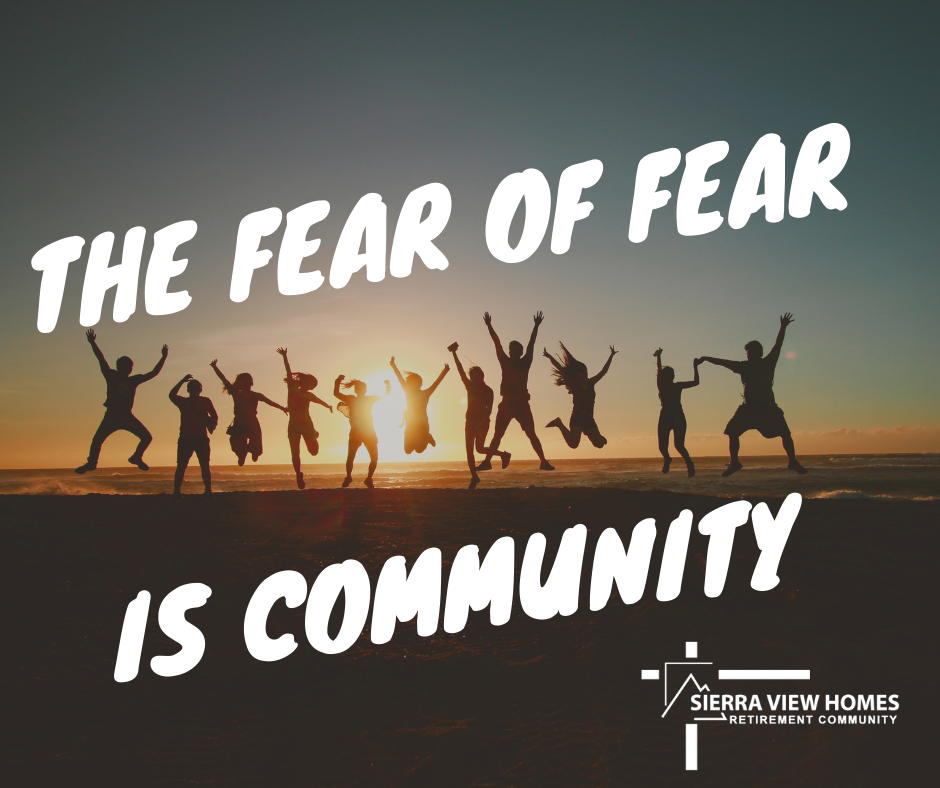
I had the opportunity to take our youth group to our biennial church conference in Kansas City several weeks ago. Dustin Gaylon, one of our speakers speaking during a morning worship session, made the comment that “the fear of fear is community.”
In the Gospel of John, as the end of his time on this earth nears, Jesus promises his disciples that he will not leave them comfortless. Before he is taken up into the sky the disciples receive the power of the Holy Spirit. But we should also not forget that as Jesus hung on the cross in John 19:25-27 he also instructs his followers to care for each other.
While the disciples were initially paralyzed with fear cowering and barricaded in a room following the crucifixion, they were soon empowered, not just by the Holy Spirit, but through the community they shared with each other as they spread the Gospel and planted new communities of faith.
The things we fear most, when brought before God and shared with our community of faith, become much more bearable. Community is a gift of comfort from God. Let us embrace it with open arms.
– Caley Ortman, Chaplain
It may come as no surprise that I have been reflecting a lot on resurrection this month. This is the season we focus our attention on the event of the resurrection.
Anticipation builds in the church as we near the end of Lent. We sing hosannas on Palm Sunday, take communion on Maundy Thursday, reflect on the seven last words of Jesus on Good Friday, and show up for the highest attended Sunday service on Easter morning to celebrate the resurrection.
But how do we keep from losing that energy when we head back to work on Monday? I believe one way to do so is by understanding resurrection as not only a one-time event found in scripture, but also a reflection of the character of God that we are to carry forth into the world.
Resurrection means seeing the good in people and in situations where the world has long given up. It means being faithful even when the work does not seem to bear fruit or “results.” And it means releasing the logic of our own minds to the mysterious wisdom of God’s plans.
Let us not stop the Easter celebration of resurrection on Easter this year. Let us go forth and embody resurrection as well, so that the world may know the love of God through our actions.
Caley Ortman, Chaplain