fbpx
Pardon our dust! We are in the middle of a website redesign.

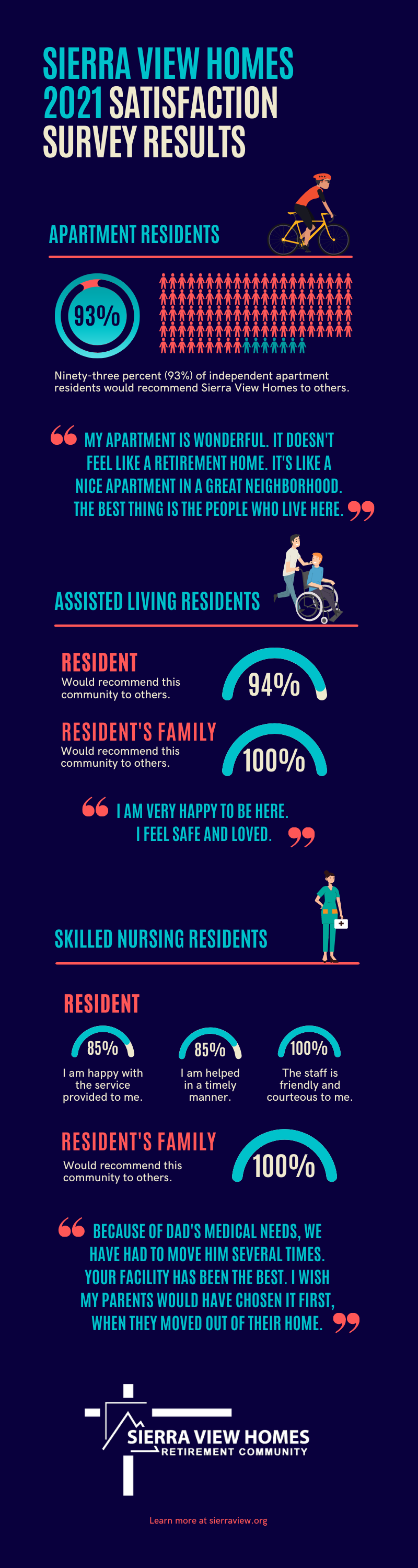
Infographic: Sierra View Homes Satisfaction Survey Results

Sierra View Homes Retirement Community sent out our resident satisfaction surveys during the summer. The questionnaire was either completed by mail or by individual interview. Of course, we are looking for a “report card” to see how we measure up, but we are also trying to understand if some areas need to be worked on.

We are pleased to report that our scores were high for each of the service lines! Certainly we want to improve all the time. Of the questions, we pulled from the ones that capture the resident’s full impression of our services. Full details may be found in the office, but we would like to summarize here for each service line:

Independent Living: 94% of residents see Sierra View Home’s apartments as a good value for the money, and 93% would recommend our community to others. A few of you would like to see more variety on the food menu and an increase in maintenance helpers.

Assisted Living: 100% of the residents and family members are “happy with the care and service that is provided.” A few of you would like to see more group activities in the evenings and weekends. 100% would recommend Sierra View Homes to others.

Skilled Care: More than 85% of residents and family members are happy with the care and service that is provided and 100% of the family would recommend Sierra View Homes to others. Some of you want more choice and participation in making decisions about their care and routines.

We appreciate your support and encouragement, especially after a very difficult year and a half. You also have given us some areas to improve on, and we will be working on them with expediency and diligence.

Service Animal or Emotional Support Animal – What’s the Difference?

Service and emotional support animals are becoming more and more common. The last time I flew to Kansas, in the Dallas Fort worth airport I counted at least three dogs that the owners kept near and one service dog helping its handler to maneuver through the crowds safely. It seems more and more people are realizing the benefits of having an animal in their life. A bakery in Morro Bay has a whole display case full of doggie treats so people who are vacationing can purchase something yummy for their dog as they sip their coffee and have a sweet roll.

When we opened the Terraces at Sierra View Homes Retirement Community, we decided to become pet friendly. That was a game changer for many people looking for a pet-friendly retirement community. As of today, we have had numerous dogs (must be small dogs) cats, birds and a bunny living in the apartments.

So, what is the difference between a service animal and an emotional support animal? A service dog is trained to do specific tasks for the disabled person assigned to them. The disability could be physical, sensory, psychotic, intellectual or other mental disability. Only a dog can be a service animal no other animal can be considered a service animal according to the ADA.

A service dog can be trained to assist an individual who is blind or has low vision and navigating streets are difficult. They can alert someone who is deaf to the presence of people or sounds. Pulling a wheelchair, assisting an individual during a seizure, and retrieving items such as medicine are a few of the things a well-trained dog can do. Each service dog is trained specifically for the person who will receive the dog.

Service animals are usually allowed in most public areas as long as the dog is under control. A service animal must have a harness, leash or other tether, unless the handler can control the animal by voice commands or hand signals.

If the animal barks, growls or jumps on individuals, the dog and the owner will have to leave the area. Service dogs help disabled people live a more satisfying lifestyle and helps their handler to live an independent life.

Service dogs are important and have a real purpose but what does an emotional support animal do? Unlike the service dogs there is no formal training to be an emotional support animal. Emotional support animals can be cats, dogs, ducks, and the list goes on. These animals’ primary role is to provide companionship and comfort to their partners who may be suffering from psychological disorders. The psychological disorders could be PTSD, chronic depression, loneliness, or anxiety. Emotional support animals give unconditional love proven beneficial to many people.

The advantage of owning a pet or emotional support animal is the need to care for it gives incentive to get up in the morning. Stroking, holding, cuddling, or otherwise touching a loving animal can have a powerful effect in lowering blood pressure. Touch and movement are two healthy ways to deal with stress. Pets encourage playfulness, laughter, and exercise. Laughing at the antics of a playful pet helps you enjoy life with a sense of well-being. Studies show playing with a pet can elevate levels of serotonin and dopamine which calms and relaxes us.

I expect to see more and more service dogs and emotional support animals in my travels and here at Sierra View Homes Retirement Community. I meet and greet residents, who brought their pets when they moved into the Community as they are walking their pets and enjoying the day. Animals do bring a sense of fun as Sassy, the cat, chases after her toy, or Sierra, the bird, tweets out a song, and the therapy dog make rounds just to say “hi.” Be it a service dog or an emotional support animal, more and more people are realizing the benefits of owning and loving a pet.

Defining Self-Care

The month of Valentine’s has arrived! Of course, soon after Christmas, the popular Cupids and red hearts were up to remind us to be in good cheer and spend some money on goodies for our loved ones.

Let’s have a little different perspective this time. I would like to remind you to take care of yourself first. Taking care of yourself fuels the good you can do in the world. True self-care is more than a collection of sayings, self-indulgence or surface-level practices. It’s taking stock of your humanness and building yourself up.

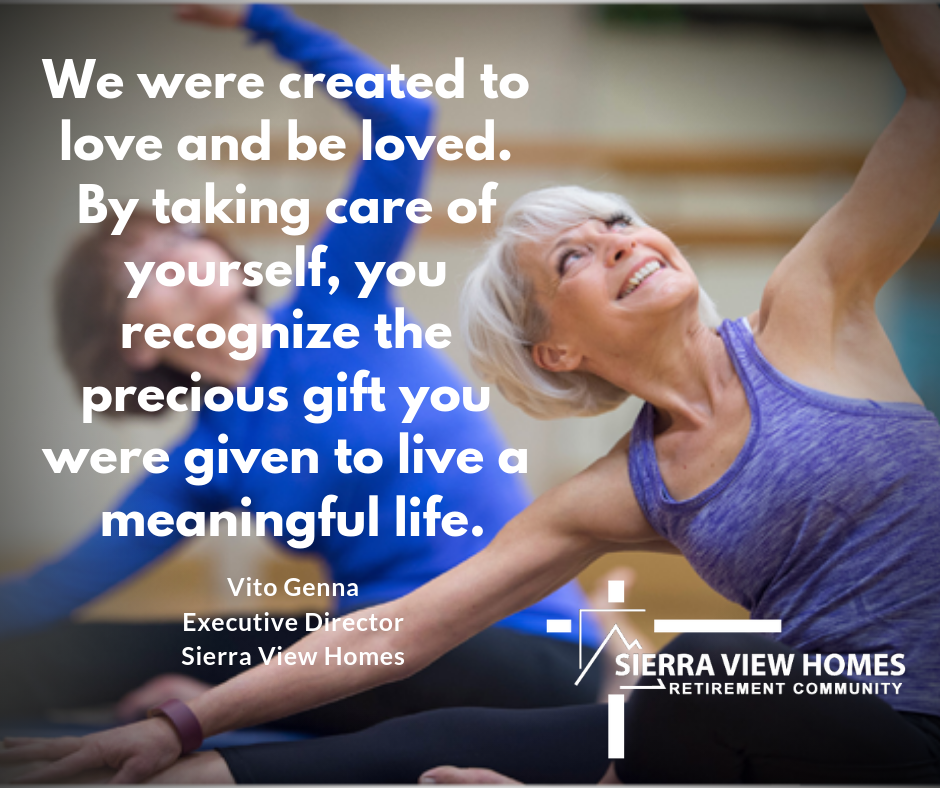
Each one of us has dignity as God’s Children. From the womb to death, each one is worth love and care. We were created to love and be loved. By taking care of yourself, you recognize the precious gift you were given to live a meaningful life. Too many, especially some care givers, give so much of themselves in being thoughtful, hard-working, persistent care deliverers, and in-addition active family members. All that caring takes a toll and we can easily see some get to a fatigue that diminishes health.

To those individuals, I say take time out for yourself. The old saying, if you don’t take care of yourself first, you are not going to be much help to others. It’s enlightening to consider self-care as an important sustainable habit that replenishes the body, mind and spirit.

Perhaps in this month, you can rework some habits that bring consideration to yourself. Is there a danger of too much pampering of oneself? For most of us, I don’t think so. The more we receive, the more we give away. May this Valentine’s Day find you replenished and able to love without limit and joyful to know that you are loved.

– Vito Genna, Executive Director

Want more articles like this? Sign up for Sierra View Homes’ monthly email newsletter! It includes events and happenings for the month along with thoughts from Vito Genna and SVH Chaplain Caley Ortmond. Submit your email address to Kecia at KFriesen@sierraview.org.

Lessons from Half a Century at Sierra View Homes

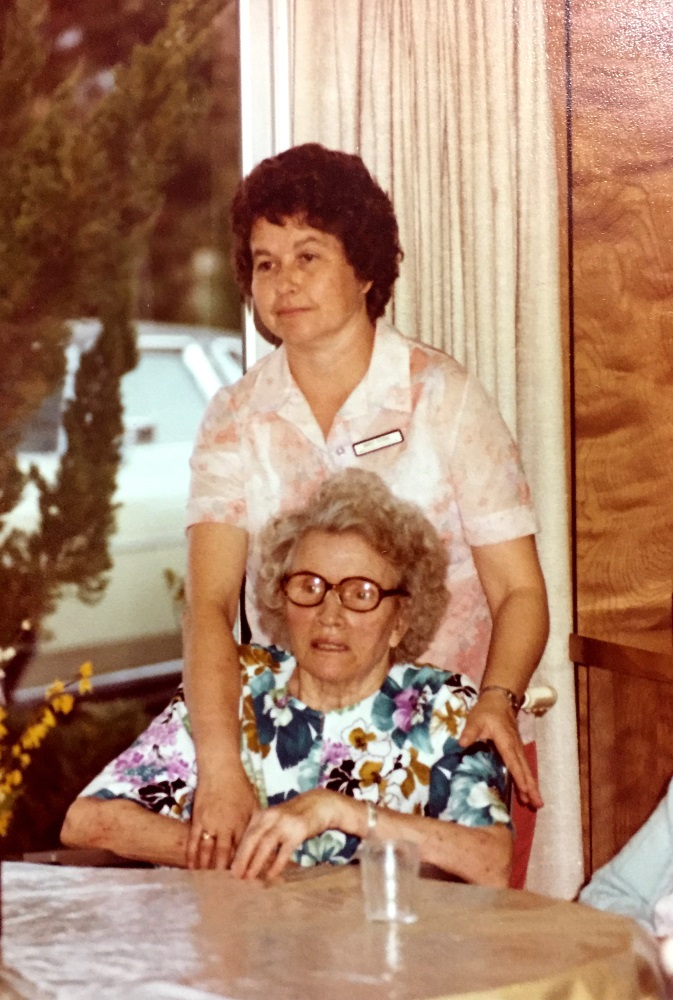
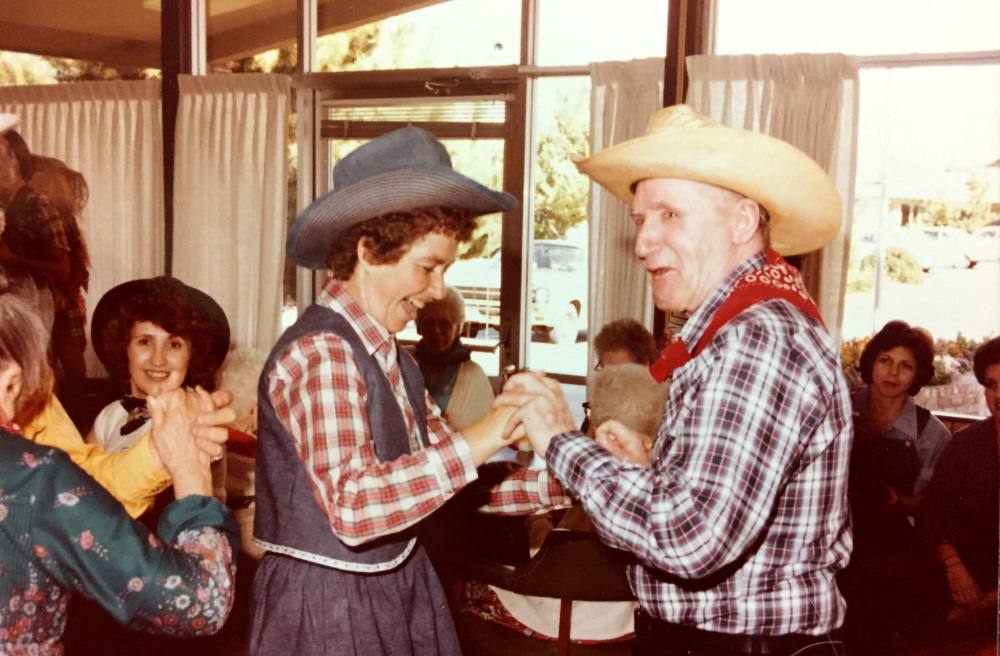
Nancy Petinak, circa 1981, dancing with a resident. “This was a really proud moment for me,” she said. “This resident suffered from PTSD and never talked or smiled. Over time, music brought him out of his shell, and he even danced. This picture captures a miracle.”

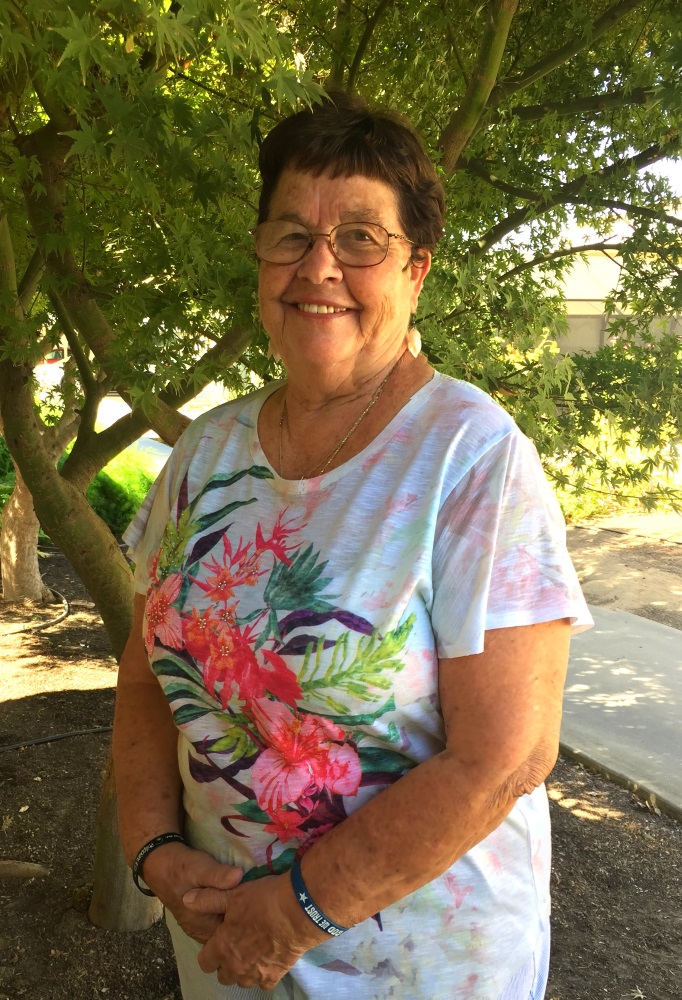
A lot changes in 44 years, but some things never change. No one can attest to this better than Nancy Petinak. The 79-year-old Reedley resident recently retired from her role as Activities Director at Sierra View Homes Retirement Community, a career which spanned an impressive 44 years.
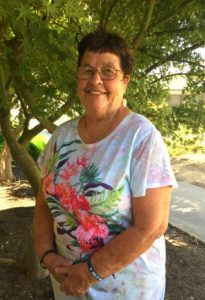
Happy retirement, Nancy Petinak! You are loved. Thank you for your service!

Nancy played a pivotal role in the growth of Sierra View Homes from a small skilled nursing facility to a full-service continuing care retirement community. Nancy’s career is a source of great pride for Sierra View, as she exemplifies the unusual longevity of the organization’s staff, and more importantly, the service-oriented heart found beating beneath the everyday workings of the community.

When Nancy first began at Sierra View in 1975, she little expected that it would be the first and only employer of her career. “I was just hired because I could play the piano!” Nancy laughed. The director at the time, Art Bergthold Sr., wanted someone who could incorporate music into activities for the residents, and Nancy set out to do just that. She added music into workout classes, sing-alongs, performances, and weekly church services.

Before long, she had discovered that this was more than a job, it was a life’s work. “I realized it was a mission, and that God had placed me here for a reason, to help people and make their lives better each day,” she explained.
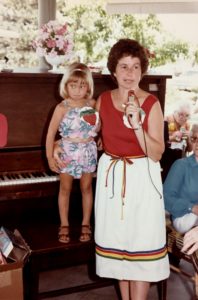
Nancy, circa 1982.

Over time, the methods she used to fulfill that mission evolved. “For many years, I focused on bringing events to Sierra View’s residents, like a Country Fair fundraiser that drew thousands of people from the neighborhoods in Reedley,” she explained. “I told our residents, if we can’t bring you to events, we’ll bring the events to you!

This philosophy, and her activity programs, were groundbreaking by necessity. “The year I started, activity programs had just begun to be required by the state, and innovations like assisted living and memory care for dementia patients didn’t exist yet,” she said. “Skilled nursing served a very wide variety of ability levels, from people who just needed a bit of assistance to Alzheimer’s residents who entered with extreme cognitive challenges.”
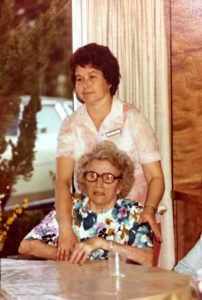
Nancy, circa 1982.

Thus, almost by accident, Nancy became a pioneer of dementia care. She established Sierra View’s Special Needs program, which laid the groundwork for Sierra View’s current Memory Care, transforming a dining room into a “neighborhood” with centers focused around everyday activities like cooking, laundry, sewing, and a home office. “We saw an immediate difference in our resident behavior,” she explained.

She recalls one particular resident, a former newspaper editor, who came into Sierra View angry and lashing out at the staff. However, at Nancy’s suggestion they added a typewriter and desk to the office area for him, and his behavior changed overnight. “He was suddenly very industrious, and typed all day long – it was like he was back to work,” Nancy said. “When we read what he was typing, it wasn’t always relevant, but it was clear that he was typing his feelings out. His family noticed an immediate improvement. They were so grateful that he was finally content and at peace.” Her program was so successful, in fact, that she visited other communities and spoke at conferences to teach about best practices in dementia care.

When Sierra View Homes’ dedicated Marden’s Place Memory Care wing was built, Nancy’s role pivoted once again, beginning to focus even more on the social needs of residents and their families. “I spent a lot of time mentoring families, dealing with individual concerns, walking residents and their families through power of attorney issues and disputes – basically helping families to understand what was happening to their loved ones,” she said. “But one of my favorite things was to sit with people and sing with them.”

In fact, over 44 years, Nancy has found that music is one of the constants. She helped bring the iPod Music program to Sierra View’s residents, where residents are provided with an iPod tailored to their individual favorite music. This has had special success in Sierra View’s Memory Care, where residents show marked improvement in happiness while singing along to their favorite tunes. “Music and scripture and prayer are the things that are never damaged by Alzheimer’s or dementia,” Nancy explained. “I’ve always told families that, and they seem to find comfort in it. Music, God’s Word, and prayer all speak straight to our heart, and that never changes.”

Another thing that doesn’t change is the service-oriented heart in Sierra View’s staff. “I’ve been blessed to work with a group of people who share my mission,” said Nancy. “Sierra View seems to draw people who want to make residents’ lives better every day, and I’ve been honored to work with many people who have really made a difference.”

Likewise, she has met incredible people in Sierra View’s residents. “One of our residents invented the little clip on pens so that you can hook it to your paper. Another invented a revolutionary design for airplane wings. We’ve had doctors, lawyers, missionaries, and Olympic medalists,” she said. “Sierra View is full of a wealth of stories and wisdom and history, just there for the asking.” So her advice to the younger generations after her? “Ask.”

Some things change – buildings rise up and organizations grow, and foundational staff like Nancy move on to new adventures. But the music, the heart of Sierra View Homes, and Nancy Petinak’s legacy, will always remain.
10 TIPS for Living a Dignified Life as You Age

“Aging with dignity is the ability to live life to its fullest in the place you call home, regardless of age, illness or disability. “ So starts an article by Victoria R Ballesteros and Athan G. Bezaetis. Both are communication professionals with the SCAN Foundation. The article they wrote covers 10 points on the topic of aging with dignity. These are good points to use to look to the future. Here is a summary of those points with some comments of my own.

TIP #1: You Are Not Alone

We have been hearing for a while now that the huge number of baby boomers are now reaching retirement age. There are not enough retirement communities, assisted living buildings or skilled nursing facilities to accommodate the numbers of people who will need care. It is important for you to talk to your family. Share with them what aging with dignity means to you on a personal level and listen to what it means for them.

TIP #2: Different People Need Different Kinds of Support

Most folks need someone to socialize with, some need help with medication management and others need some help to make sure they eat nutritious foods. Older individuals with health conditions that make routine activities difficult need specialized help. There is help for giving care in the home. Contact your Area Agency on Aging, Medi-Cal office, and your doctor to find out what help is offered in your area. There are no free services; however, there are people who are willing to volunteer occasionally. A good place to look for volunteers is your church.

TIP #3: Family Member Support Counts.

Family is a vital part of aging with dignity. Family members do many kinds of hands on care for individuals who have health needs. Someone in the family often helps with finances either managing money or helping to pay for needed help. Emotional support is an important family contribution. This can be challenging when you also have to grieve the loss of health and vitality.

TIP #4: Plan for Expensive Long-Term Care

Hiring people to provide care in your home can get very expensive. I understand a certified nursing assistant is being paid more than $15 per hour in most cases. In-home support organizations are charging $25 per hour and above. Nursing Homes are trying to keep costs to the resident as low as possible, but ever increasing environment regulations forces the cost of providing care to continue increasing. Many nursing homes cost $7000 a month and above.

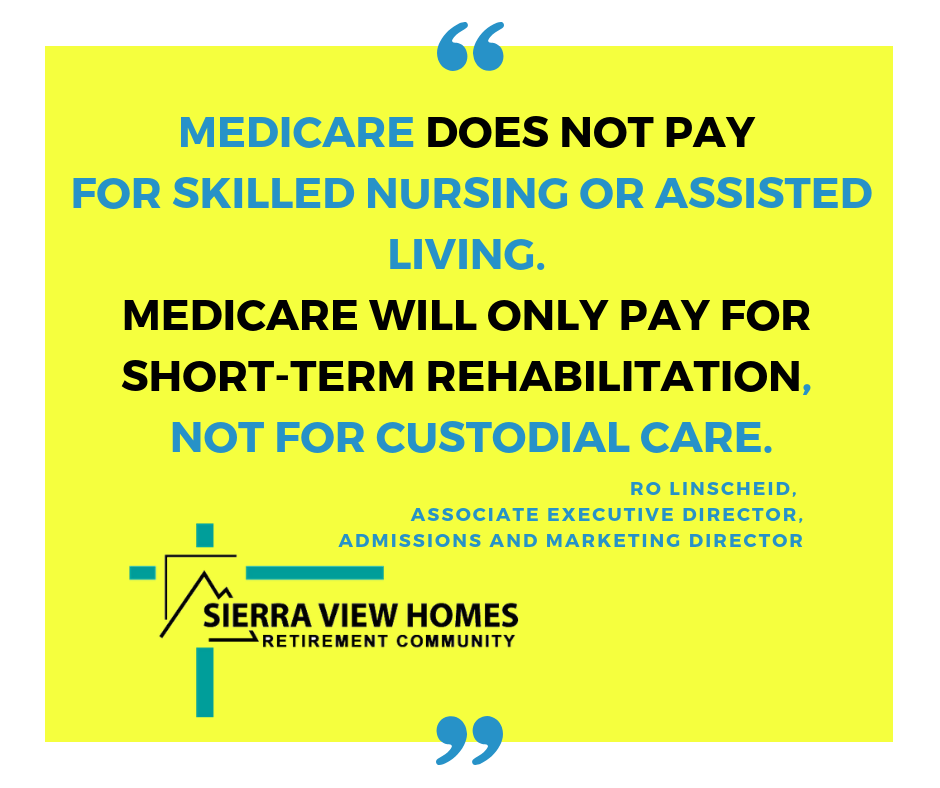
TIP #5: Medicare Does Not Pay

I get a number of calls each week with the question, “Does Medicare pay for my loved one’s stay in Skilled Nursing or Assisted Living>” They are so surprised when I have to tell them Medicare does not pay. Medicare will only pay for a short-term rehabilitation stay not for custodial care. If you stay longer in a Skilled Nursing Home, you will have to pay out-of-pocket. If you end up spending all of your assets, you may then apply for Medi-cal, California‘s version of Medicaid. Medi-Cal has several programs to assist you in paying health care costs.

TIP #6: Talk to Your Loved Ones.

Planning is important. Decisions are extremely difficult when a crisis happens. Has a Durable Power for Health Care been established? If it has, how old is it, and are the agents listed in the document still able to fulfill the functions assigned to them? Are health care wishes spelled out in the document, or have there been explicit conversations with the Durable Power agent so the wishes can and will be honored when that time comes?

TIP #7: Talk to Your Loved One’s Doctors

Aging brings health care changes. Being a strong advocate for someone who is aging means you need to know about what the doctors feel is the right treatment. Do you have the right specialists? Are there contradictory issues or treatments going on? Doctors do not necessarily talk to each other.

TIP #8: Build a Circle of Support

The Durable Power of Health agent is certainly an important person in the life of someone who is aging. It may also be important to have discussions with your loved one’s attorney, financial planner, insurance provider and other family members. It is never an easy task to bring everyone together, but it is important to bring all people involved into the decision-making process to honor your loved one’s wishes and desires.

TIP #9: We All Have Different Definitions of Aging with Dignity

We all want to age with dignity, choice and independence. We want to live life to the fullest regardless of age, health care issues or ability. Be sure you understand how your loved one defines aging with dignity and make that part of the master plan.

TIP #10: Get Involved

Decisions are being made at the state and federal level that could impact the services available to you and your loved ones. Stay informed and speak up by talking to your local, state, and federal officials. The SCAN Foundation website can keep you updated.

Aging with dignity is important and creates less fear in the aging process. At Sierra View Homes Retirement Community, we strive to do person-centered care to increase dignity in the lives of the people we care for. We care-plan the resident wishes in the Residential Care/Assisted Living Facility, keeping the resident center in the plan of care. There are activities for the independent living to help foster friendships and a sense of belonging and to stay physically agile. The goal is to provide an outstanding environment that promotes dignity and a sense of well-being.

For more information about Sierra View Homes Retirement Community, please contact Crystal Rogalsky at (559) 638-9226 and crogalsky@sierraview.org.

Glide into 2017

rockingchair_slider

In this high tech world with all the gadgets that promise to make your life better, we are now seeing that a simple rocking chair can improve your health and your overall sense of well-being. Before you conjure up some antiquated image of an old person in a rocking chair, you need to see the evidence. Studies are being conducted by a number of leading colleges on the possible benefits of spending time rocking in a rocking chair.

Many of us have spent time rocking or gliding enjoying the soothing relaxing movement. Researchers are showing that rocking chairs help to reduce pain. The spinal cord can work in only one direction. So, when the brain is sending impulses down to the legs to push the rocker the pain receptors are blocked. President John F Kennedy got relief from his chronic back pain by spending time in a rocking chair.

Rocking chairs have been shown to improve the emotional health of those suffering from depression, anxiety and/or dementia. Researchers found by simply rocking back and forth in a rocking chair for at least an hour a day improves the psychological and emotional well being of the person rocking. No study reports why this works, but the results show the more rocking you do the better the results.

A team in New York State Department of Health did a rocking chair study of 25 nursing home residents who were diagnosed with dementia. After six (6) weeks of monitoring the residents, rocking for at least an hour a day, the team found the residents were emotionally calmer. Anxiety, tension and depression were decreased and these residents required less pain medication.

A surprising benefit was the residents had better balance after rocking. The light exercise that happens while rocking burns calories, improves knee extension, and strengthens calf muscles giving residents better ability to stand up straight.

Recently, with a memorial monetary gift from the Wendell Rempel family, Sierra View Homes purchased six (6) new rocking chairs for Marden’s Place, our assisted living memory care unit. The chairs are unique in that when you sit down in them the chair stays firmly in place. When you lean back the rocking mechanism releases and the chair starts moving. This initial engagement is a great benefit to the residents who could be unaware of how to make a rocking chair move. The residents start to rock and often will keep the chair moving. When it is time to stand up the rocking mechanism disengages as the person leans forward to stand. Once again the chair is solid with no motion.

The rocking chairs are used regularly and are frequently requested by the residents. Rarely do I see a chair-sitting idol. The staff in Marden’s Place tells me the chairs have made a difference in how they care for the residents. “The residents are more calm and they seem happier,” a staff member recently told me. Another staff member said her “residents seek out the chairs and are disappointed if they are all in use.”

Rocking brings a safe activity to people who live a sedentary lifestyle. It does not make up for strength–training such as lifting weights but it has value in increasing strength, decreasing pain and creating a sense of well-being in a person who rocks regularly. So, my advice is to dust off those old rockers and place them in a place of prominence and glide or rock on through 2017.

Food: Seniors Want Fresh, Organic, and Made-to-Order in a Fine Dining Atmosphere

healthyfood

Photo courtesy of notyourstandard.com.

Eating organic foods, more fresh produce and less processed food seems to be the current trend. Seniors are starting to rally to that table of fresh, homemade food, even after a lifetime of poor eating habits. People who are coming to live on retirement community campuses are demanding food choices that promote a heart healthy diet. It is important for food service to meet the needs and the wants of the people who live in the community.

Today’s social norms have pushed meal times to be fast paced, perhaps an inconvenience. Mealtime is a social time for seniors. It is a time when residents enjoy visiting with family and friends. The wait time and coffee after is spent visiting listening to hear the tales of the day. Quality of life is most visible at meal time. Retirement Communities’ food service keep asking the question: Is the food not only presented in an appetizing and appealing manner, but is it true to the needs and desires of the resident?

Many years ago when I started working in long-term care much of the food served was processed. There never was any fresh fruit or fresh salads. The vegetables were always cooked till they were soggy and the amount of salt in all the food was staggering. Every Resident Council and Care Plan meeting had food complaints and concerns. Dietary staff was simply charged with getting three meals a day out to the residents. There was the main dish, which was served to everyone. If someone said “I don’t like that,” the server would go back to the kitchen for the alternate most likely a sandwich, and that was the end of choices. Standalone nursing homes were especially prone to a dull plate. As retirement communities and assisted living communities started paying more attention, nursing facilities followed. Now Medicare pushes the care of residents in Skilled Nursing to a more resident-centered care and food service also needed to change. Food choices are important. Having healthy choices for residents has become a priority. New people moving onto the retirement community campus have become more vocal about having healthy food choices. Food committees have sprung up to help dietary services understand what is desired for the food choices.

Of course, expectations for improved food services and experiences present senior living communities with a variety of challenges. Residents may have religious; cultural or ethnic food needs or preferences. Food allergies have become more common. Making sure people get the right diet therapeutically and by preference takes a vigilant staff keenly aware that each person needs to be served the right foods. Also, the multitude of plates have to arrive at the table hot, tasty and appealing, all within the one hour of the mealtime window.

Sierra View Homes is working toward increasing healthy food choices for the people who dine here. Meatloaf and mashed potatoes are still served on occasion but it is more likely you will see a fish choice on the menu. Actually I can’t knock the Sierra View Minerva Meatloaf. It is many resident’s favorite dish which is a favorite of many residents. A salad bar gives a choice of fresh greens and fruit. Sierra View has a garden planted on campus for the community to harvest for their own meal planning.

Giving choices of healthy food for today’s seniors is of great importance to the quality of life at Sierra View and other retirement communities. Having good food choices goes a long way in the satisfaction of the community residents who are working hard to have a long and healthy life. So, like our residents, I take the fresh, organic made to order by our chef in our fine dining room. As the Italians’ say “Bon Appetite” the German’s say ”Mahlzeit”.

Never Take Your Feet for Granted

baby-feet-of-a-newbornFeet. They carry you from here to there every day. Typically, we don’t give much thought to our feet until we experience pain.

Foot problems tend to be common in older people for several reasons:

  • As we age the bottom of the foot loses its cushioning making the foot more susceptible to bruising
  • Older skin can become dry and brittle, causing open areas, especially around the toes
  • Joints can become inflamed by poor circulation
  • Diabetes and can keep a foot wound from healing properly.

One way to avoid foot pain is to wear comfortable shoes that fit. Avoid tight or high-heeled shoes that put undue pressure on certain areas of the foot. Constant rubbing and pinching from shoes that don’t fit properly can cause corns, calluses and bunions. Feet change in size and width as we age, so it is a good idea to get fitted every time you buy new shoes.

Another way to avoid foot pain is to keep the blood supply flowing to your feet. Walking, stretching, or doing some type of exercise improves circulation providing benefits to more than just your feet. Avoid sitting too long especially if you like to cross your legs. Avoid tight socks, which can cut circulation causing pain or slow wound healing.

When your feet hurt it is important to know the problem to get the right treatment. Talk to your doctor if you are having foot pain to get a proper diagnosis and treatment for your pain.

The following foot issues affect many of us as we age:

Plantar Fasciitis

I have been dealing with Plantar Fasciitis for the past few months. I know firsthand how difficult everyday tasks are when foot pain is intense. Plantar Fasciitis is the inflammation of the band of tough tissue connecting the heel bone to the toes. The pain is usually more intense in the morning as I get out of bed. I also find the pain is quite intense after I have been sitting a while. To heal Plantar Fasciitis, you may need to rest your foot, and use arch supports and add extra cushioning to your shoes. Patience is important because the foot pain can return if you try to do too much too soon.

Athlete’s Foot

Athlete’s Foot is another challenge for seniors. You don’t have to be an athlete to develop this fungal infection. Warm, dark, moist areas, like a foot inside a shoe is a perfect environment for this fungus to grow. Symptoms of athlete’s foot are redness, blisters, peeling and itching. Changing shoes every oth
er day to allow the shoes to dry out, use cotton socks and after a shower or bath dry your feet especially between the toes. Wearing sandals allows the feet to breathe.

Corns and Calluses

Corns and calluses can be very painful. They can certainly limit your activity. The best way to avoid corns and/or calluses is to wear properly fitting shoes. There are numerous over the counter remedies for this issue, but there is a possibility you could cause more damage and have further pain. A podiatrist can help you deal with corns and/or calluses especially if you are diabetic or have poor circulation.

Hammertoes

Hammertoes happen when the shoe is not wide enough at the toe and the knuckle swells pulling the toe back. This can cause a balance problem for seniors that could result in a fall. The best way to prevent a hammertoe is to wear properly fitting shoes with ample space for the toes. If you suspect you have a hammertoe, see your doctor or podiatrist for treatment.

Ingrown Toenails

Ingrown toenails can become infected and extremely painful. It is good to check your feet frequently and to trim your toenails carefully leaving a little of the white so as to keep the nail from pushing into the nail bed. Cutting toenails too short can lead to problems of infection and pain.

Diabetes and Feet

If you are diabetic, it is extra important to pay attention to your feet. A minor corn, a cut or a callous can become life threatening due to the issues diabetes can cause. Diabetes can cause the blood vessels to shrink causing a wound to heal very slowly or not at all. It can also damage nerve endings leaving you unaware that there is a problem with your feet. Lack of circulation or lack of feeling can lead to some very serious consequences such as amputation. It is extremely important that you check your feet every day, especially if you are diabetic.

Blood flow to your feet is vital. Get up, move around, do stretches, and take walks, all of which keep a healthy flow of blood traveling to your feet. Sierra View Homes Retirement Community has many paths to take a walk, there is a heated pool for swimming and exercise equipment to build strength. You will walk better and farther with proper fitting shoes with good support and have good cushioning. A podiatrist comes on campus to care for the more difficult foot care issues.

This is not a complete list of possible problems that can happen to your feet. Foot pain can really hinder quality of life. It is important to pay attention to your feet. Watch for problems and address them quickly. If there is a problem, see your doctor to get treatment and keep moving for a long and healthy life.

Stroke: Know the Warning Signs!

“I have met a number of people that have had a stroke. Each one has had different consequences- some severe and some with hardly any visible effects. Are there warning signs and can you discuss the different effects strokes have on individuals?” – G.L. of Reedley

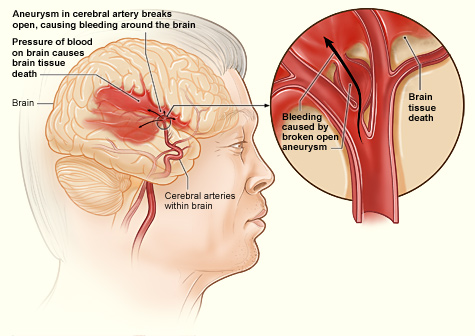
The medical terminology for a stroke is a cerebral vascular accident (CVA). A CVA is caused by the blockage of blood flow by a clot or a rupture of an artery in the brain. This can result in sudden death of brain cells due to lack of oxygen. Strokes can create all sorts of disabilities. Depending on where in the brain the stroke happened you can have trouble speaking, the extremities of one side of your body could be limited or not work at all. Reasoning skills could be hindered, eye sight may be changed, or the muscles for swallowing could be weakened. The list of possible disabilities goes on and on. Damage from a stroke can lead to death. Statistics show strokes are rated 3rd in the leading causes of death.

Transient ischemic attack (TIA) is a small stroke, sometimes referred to as a warning stroke. These strokes have the same symptoms as a (CVA) stroke but there is no lasting damage. The symptoms appear for a short time and then recede and your body goes back to normal.

Each year hundreds of thousands of people have strokes (CVA or TIAs). Both of these types of strokes need immediate attention at a medical facility. There is no way to tell if you are having a TIA or the more damaging CVA. Whether or not you recover from the stroke depends on getting to the hospital quickly. There are clot busting medications now that can eliminate or reduce the damage done by a blood clot in the in brain. The blood clot busting medication can reduce long-term effects if it is administered within three hours of the start of the symptoms.

It is important that everyone recognizes the symptoms of any type of stroke:

  1. Sudden numbness or weakness of the face, arm or leg, especially on one side of the body.
  2. Sudden confusion, trouble speaking or understanding
  3. Sudden trouble seeing in one or both eyes
  4. Sudden trouble walking, dizziness, loss of balance or coordination
  5. Sudden, severe headache with no known cause.

If you or someone you are with has one or more of these signs, don’t delay to call 9-1-1. It is best to get an ambulance to the scene rather than take the person to the hospital yourself. The ambulance is equipped with emergency equipment. It is good to check the time when the symptoms started. There is a very small window of time to get the necessary medication to circumvent the effects of the stroke. The brain cells start dying quickly when they are deprived of oxygen.

It is difficult to treat a stroke if there has been a delay in getting to the hospital. Reasons for the delay can be denial “I have got this little problem. If I ignore it I am sure it will go away.” Maybe there is nobody around when the stroke happens. If you live alone or are alone for extended periods of time I encourage you to form a buddy system to check up on each other or get something like Lifeline so you have a way to call for help. Fortunately on a retirement campus like Sierra View Homes neighbors look out for each other and are more aware of symptoms to be alerted for. Another reason for the delay is lack of understanding how important it is to get the victim of the stroke to the hospital quickly. Not calling an ambulance can delay treatment.

Not everybody has full recovery from a stroke. Some strokes are caused by bleeding in the brain. Clot busters do not work on this type of stroke. Some areas of the brain when deprived of oxygen just do not come back to full function.

Rehabilitation therapy for the stroke usually follows a stay in the hospital. Therapists try to reprogram the effected area. The first year following the stroke is the period when it is possible to make the most progress toward prior level of function. Once the first year anniversary is passed progress becomes extremely limited. Sierra View Homes rehab center has had a lot of success in improving residents function in both the outpatient and inpatient programs.

The risk factors for having a stroke are high blood pressure, elevated cholesterol, tobacco abuse, diabetes and aging. Also, heart rhythm disturbances like atrial fibrillation and heart disease can cause strokes. Specialists are studying if there can be an inherited predisposition to strokes.

Strokes can be devastating and change the quality of your life. It is important that you looks at the risks factors, makes adjustments in life style to reduce the risk factors and heed the warning signs if they appear. Get to a medical center quickly if you suspect a stroke. Remember the three hour window. If you live alone make sure you have a system to get help in an emergency. Be alert and aware that someone around you could be in trouble so I encourage you to know the warning signs and assist as needed.

Understanding the Durable Power of Attorney

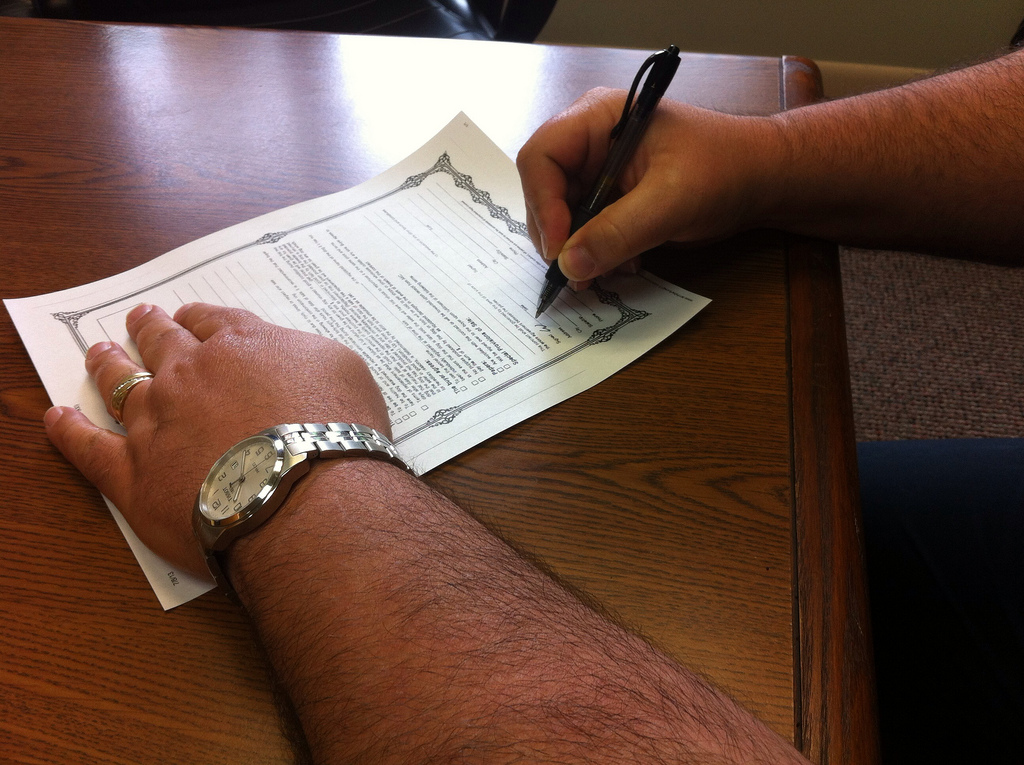
Image by Dan Moyle - Creative Commons (https://flic.kr/p/f5j58F)

Durable Power of Attorney for Healthcare and Finances

What happens if you should suddenly have a life-threatening emergency? You are unable to talk and unable to tell the medical professionals what your wishes are. The medical personnel have taken an oath to do everything possible to save you. They may give you medical attention you do not want.

As you look to the future it is important to put safeguards in place to make sure your wishes are carried out through the rest of your life. There are things you can do at any age to put your wishes in writing and designate someone to follow your decisions in case you are unable to do so.

A Durable Power of Attorney for Health Care (DPOA) enables you to designate another person, called the attorney-in-fact (agent), to act on your behalf regarding healthcare issues. It is important you pick an agent who understands what your wishes are, and promises to follow you guidelines. Some people pick family members, others pick a friend. Be sure this person is aware of and agrees to what you are asking them to do. There is a place on the form to designate a second person in case the first one cannot fulfill the responsibility. I feel the second person should be someone younger than you are. I often see DPOAs that list the husband or the wife of the person being admitted to the Sierra View Homes Nursing Care. There are times when that person is too emotionally distraught or unavailable to do the job.

The DPOA not only states who is to be your agent but also states what your wishes are regarding end-of-life issues. Do you want to be kept alive no matter what?

You can state what limitations of treatment you want. Be specific with timelines of treatment procedures and when it is time to discontinue them.

The DPOA can be prepared and is filed away for future use or you can have it be in affect right away. It is important to have this document in your doctor’s office and with the person who will be acting at your agent. Hospitals, nursing homes, assisted living facilities and doctors respect the DPOA for Healthcare.

You can find the form for the DPOA for Healthcare online, in your local nursing homes or you can have a lawyer draft one for you. After you complete the form, two witnesses must watch you sign it. These two witnesses must have no direct interest in how long you live. It should be two friends rather than two family members. Once the signatures are in place the document is legal. If you would prefer, you could have the document signed with a notary. When you use a notary you do not need witnesses. There is a different procedure that must be followed when you are a resident in a nursing home. There is a law that states the DPOA must be completed in the presence of an Ombudsman. The Ombudsman serves as a neutral third party to ensure the resident in the nursing home is making the choices of their own free will.

Durable Power of Attorney for Finances

What happens if you cannot take care of your financial obligations because you have a serious health issue or struggle to understand all the bills? There is a Durable Power of Attorney for Finances to name an attorney-in fact (agent) to act on your behalf. Your agent is given the ability to handle your financial affairs. It is important to state in your document if you want your agent to handle your affairs on an ongoing basis or for a short period of time, immediately, or in the future. You can limit what your agent can do for you. But keep in mind that if you become unable to continue handling your affairs the limitation may cause problems.

It is important you find an agent, who can and wants to handle the task. This person needs to be someone you can trust, who keeps good records and will be around for an extended period of time. Talk to the person you have chosen so that they understand what you expect of them. Be sure they understand what their responsibility will be. The DPOA for finances should be on file where you do business.

At Sierra View Homes Retirement Community, I have seen how difficult it is when the resident has no documentation explaining what his/her end of life wishes are. Often families are emotional or in disagreement with each other when it comes to making difficult but necessary decisions. Residents who have completed a DPOA for Healthcare have already expressed what their wishes are and have designated someone to follow those directions. Some of the guidelines may not be what the family members want but they can follow through knowing this is what my loved one wants.

The fact is, we are all living longer and statistics show that many of us will have some form of disability in the future. I encourage everyone to take steps to ensure your wishes are documented. Talk with someone you trust to determine what your wishes are and who you want to act as your agents. Then get the DPOA for Healthcare completed. Likewise think about your finances and who you would like to help you if you could no longer take care of your own finances. Then get that DPOA done too. Both forms are good until you decide to change them. It gives you peace of mind to have some of those hard decisions determined.