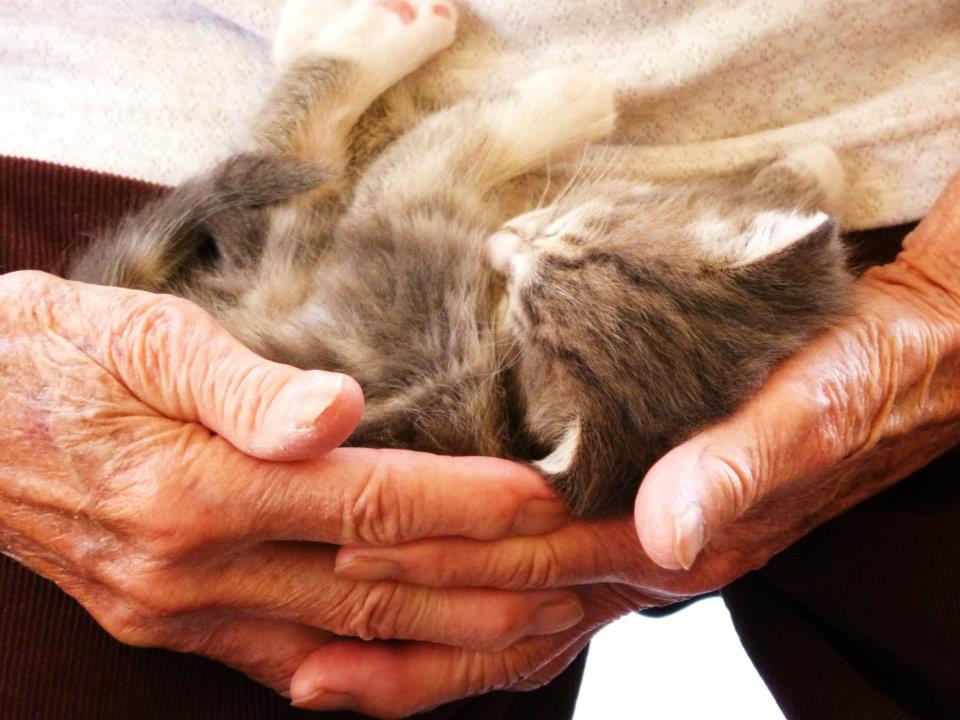
Looks like this kitty enjoyed her visit to Sierra View's nursing care center!
Pets can be good medicine.
Do you own a pet? Pet lovers are quick to tell you about the immediate joys of pet ownership. At Sierra View, we pride ourselves in our lenient pet policy, which has allowed many independent and assisted living residents to bring their furry loved ones with them. As a result, our campus boasts many non-human residents – from small dogs, cats, birds, and fish to a friendly bunny who hops down the Sierra View hallways on a leash!

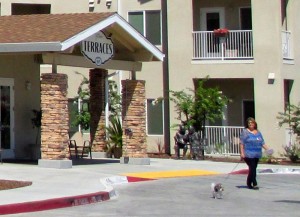
A common sight in the halls of The Terraces, Sierra View's independent senior apartment building.
One resident of Sierra View Terraces senior apartments told me she has always had a pet. “When you live on the ranch you must have dogs,” she said. Her small dog lives with her in her Sierra View Terraces apartment, and makes friends with passers-by on daily strolls around the neighborhood. “The companionship is special, and I am so thankful for my dog. He lets me know when someone is walking up to my door, and is a great conversation starter when we meet people on our walks.”
Researchers have been looking at the possibility of health benefits for pet owners. Studies on the effects of owning and caring for a pet have revealed that pet ownership can bring remarkable results for your health.
Studies show that pet owners are less likely to suffer from depression. Pet – especially dogs and cats – fulfill the basic human need for touch. They offer unconditional love, attention, and companionship. Caring for a pet can boost your morale and bring pleasure to your days. Pets require regular feeding and exercise so, no matter how depressed, anxious or stressed you are, your pet needs you to care for it. Being needed, and the job of taking care of an animal, can give your life purpose and provide a sense of self-worth. Veteran groups have seen amazing changes in depression with disabled soldiers. Some animals can even sense a person’s mood and purposely try to change it.
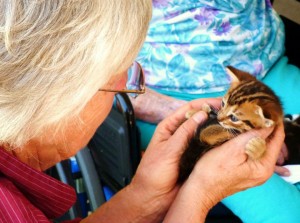 Stroking, holding, cuddling, or otherwise touching a loving animal can have a powerful effect in lowering blood pressure. Touch and movement are two healthy ways to deal with stress. Pets encourage playfulness, laughter, and exercise. Studies show that playing with a pet can elevate levels of serotonin and dopamine, which calm and relax us. Laughing at the antics of a playful pet helps you enjoy life, and adds to your sense of well-being.
Having a pet can also be heart-healthy. Research shows that heart attack patients who have pets recover more quickly and have longer life spans than non-pet owners. Going for walks with your dog, riding a horse, or chasing a kitten keeps you moving in heart healthy ways. “My dog has to say hello to everyone, and that makes my walks with him take a long time,” mentioned a Sierra View resident. “So I end up getting more exercise!”
Pets also help us take better care of ourselves. When you have a pet, you have to be there to take care of it. In fact, pet owners over age 65 are less likely to need to visit the doctor with ailments. Pets encourage laughter, playfulness, and exercise. All three boost your immune system and increase your energy.
 A pet does not have to be a cat or a dog. There are many animals to consider. When you decide to get a pet, look at your home environment, your time commitments, how active you are now, and who else lives in your home. Some pets require more time than others, so think about what the pet requires and if that commitment works for you.
Pets are not for everyone. It is important to weigh the pros and cons when considering a pet. Food, shots and equipment can represent a significant financial investment. Some animals, especially dogs, may need training and ongoing time for walks and outdoor play. The time commitment cannot be shortchanged, so it is necessary to look at the time you can devote to a pet. Additionally, a particular pet’s lifespan and adult size should be considered – for example, some tortoises sold in pet stores can live up to 100 years and grow to weigh hundreds of pounds.

Throughout our retirement campus, Sierra View Homes Retirement Community has several birds and aquariums for residents to enjoy. Sierra, one of our most popular birds, can often be found on a resident’s shoulder happily taking a break from sitting in her cage. Recently, three-week-old kittens brought smiles and cuddles to many people in both our Nursing Care Center and Assisted Living. We also have visiting animals, such as a therapy dog that stops by frequently to cheer up anyone who wants a bit of love.
Owning a pet has many positive attributes. If you (or your parents) are feeling down, stressed out, lonely, or have health issues, consider purchasing a pet. Researchers have found the pet owner feels remarkably better in just a few short months. As we age and our families and friendships change, caring for a pet can give you the lift you need to stay healthy and happy well into the future.
Planning for the Senior Years
Recently, Vito Genna, Executive Director of Sierra View Homes, and I were talking about our parents. Both of us had the experience of parents who had their documents in order and were easily accessible when each of us needed to deal with our respective parent’s business and health issues. Keeping important papers in a designated location is important especially if a family member needs to take responsibility for your financial or health well-being while you are alive and as in my case, after death.
As we grow older it is important to do some estate planning. Many seniors may think a Last Will and Testament is all they need to take care of estate plans, but that is far from the truth. Here are some additional issues that should be thought about, discussed with family, and decided upon before these decisions must be made.
One area where you can plan ahead is funeral arrangements. I know some people feel very uneasy about preplanning their own funeral, but by doing so you take the burden off your family and you are able to have control over your own arrangements. Now, there are several funeral homes in Reedley. They have insurance plans that can be set up to preplan arrangements. My mother did such an arrangement. When I had to use it, I was amazed at how many decisions were made in advance. My sister and I had very little decision making to do at the time of her death; I simply followed her plan.
Each person in your family should have a Durable Power of Attorney for health and another one for finances. Durable Power of Attorneys are legal documents that all health professionals, hospitals and financial establishments recognize. They are used only when you are no longer able or no longer want to make decisions on your own behalf. Each of these documents contains the person’s name that has agreed to act, as your agent. The Durable Power for Health care allows you to establish end-of- life decisions. What is nice about the Durable Power documents is that they allow you to spell out your wishes and the agent agrees to follow your wishes. This way you can have peace of mind that the wishes about your life will be carried out.
Collect the following documents into a general location to keep them accessible if your Durable Power Agent needs to step in an take care of business. Place your existing will, existing trust documents, existing community property agreements, copies of deeds, or title insurance that show legal descriptions of real property in a safe place that your agent knows. Documents such as life insurance, long-term care insurance and your Durable Power of Attorney should also be included. Descriptions and values of gifts made in the last three years and descriptions and values of property placed into a trust in the last five years are good to include too. If possible, copies of some of these documents should be given to the agent. Many residents at Sierra View Homes Retirement Community make sure copies are at their children’s homes.
It is a good idea to make an inventory of your assets and liabilities. For example, make a list of what you own, where your bank accounts are, your financial portfolio, and precious stone jewelry are some examples of asset information to gather. Also, make a list of liabilities such as outstanding loans, mortgages, and credit card debts.
Another area to plan is estate planning with your family and loved ones. You need to decide who should be the executor of your will. This person should be talked to before you give them the job. The executor is the person to see to all the details of your business both in paying the bills and then distributing what is left to the beneficiaries after you die.
Prepare a basic identity file. In this file keep your full name, any names you previously used, your address, birth date, and Social Security number. Include in this file the same information for your spouse and your children. The names and address of all beneficiaries named in your will are important to keep up to date. Place in the file information about your military service and/or veteran disability status if applicable.
There is the question of where to put this information so it is safe and accessible when your Durable Power of Attorney agent needs to step in. I suggest you get a safety deposit box at a bank, or place the information in a safe that cannot be easily stolen.
We are all in this world only for a time. Walking through the senior years can be less stressful with a little preparation. I was fortunate my mother kept her important information in a safety deposit box at the bank and in a specific drawer in her house. I could easily step in and work out the details of her estate. I was able to help her live out her days as she wanted, and be her voice both in life and after.
Spring Has Sprung at Sierra View!
The Art of Aging Gracefully
Ever wonder why some people seem forever youthful, and others seem older than their years? As it turns out, genetics are not the only factor – there are actions you can take and attitudes you can adopt which will help you age gracefully for years to come.
As we age it is important to laugh. Laughing aids circulation, it increases respiration, lowers blood pressure, stimulates digestion, and decreases stress. Statistics show that people who have stress have a shorter life span. It is important to find ways to release the stress we feel as we age. Do not get worked up about things you can’t control. Look at what causes your stress and look for ways to release the stressful feelings. Focus only on the things you can control. The rest will be what it will be. If you can embrace your situation right now you have learned the art of “embracing your circumstances.” By being content with the way things are, you are able to let go of the stress that can shorten your life and gives way to a sense that all is as it should be.
Movement helps to keep you aging gracefully. Activity increases your sense of wellbeing. Doing exercise that increases your heart rate gives your cardiovascular system a boost and keeps your joints moving. I encourage you to find interesting and engaging physical activity that you can do several times a week. Activities that encourage deep breathing help to relax the muscles and increase the sense of wellbeing. As we age our breathing may get shallower. Your body needs good air exchange to optimize immunity and increase its ability to heal. I am encouraged to breathe in deeply through the nose and out through the mouth as I encounter the exercise classes around Sierra View Homes.
Getting some sun helps to boost the vitamin D in your body, which helps the body absorb calcium, and improves the immune system. If you can’t get into the sunshine taking vitamin D tablets works well too. Vitamin D increases levels of serotonin, a neurotransmitter that boosts your mood. It is important to remember that if you are planning to be out in the sun for a long period of time it is important to wear sunscreen. Lack of protection can lead to sun damaged skin or even skin cancer.
Sleep is one of the most important components of aging gracefully. Sleep refreshes not only your body but it gives you a boost emotionally. Sleeping at least seven hours a night should be your goal.
Exercising your brain helps to ward off memory loss. Learning something new, doing crossword puzzles, or some other game that requires thought or memorization helps to keep your mind young.
Take a look at what you eat. A diet that has a lot of fruits and vegetables gives your body the nutrition it needs to ward off diseases. By filling your plate with colorful fruits and vegetables you will eat an array of antioxidants and phytochemicals that promote healthy aging by boosting your immune system.
Drinking water makes the skin look more refreshed, youthful, and hydrated. Most people do not drink enough water.
Food rich in Omega-3 have been shown to make a difference in reducing the risk of memory loss as you age.
Norine Lambdin, a resident at Sierra View Homes Terraces, explains that her philosophy for aging gracefully focuses on the positive. Her faith in God teaches her not to dwell in the past but to rejoice in the present, “You cannot change what has been. Forgive the wrongs of your past and embrace today.” Norine enjoys meeting new people and looks to surround herself with positive people who enjoy laughing and are encouraging to others. Hiking in the Sierras each week with a group of friends is a highlight of her week and she encourages others at Sierra View Homes to be active and involved in the activities offered on and off the campus.
Doing a little bit each day gives you the ability to age more gracefully as time goes by. Living a long and healthy life full of laughter, good food, and plenty of social and physical activity is my wish for you.
Stroke: Know the Warning Signs!
The medical terminology for a stroke is a cerebral vascular accident (CVA). A CVA is caused by the blockage of blood flow by a clot or a rupture of an artery in the brain. This can result in sudden death of brain cells due to lack of oxygen. Strokes can create all sorts of disabilities. Depending on where in the brain the stroke happened you can have trouble speaking, the extremities of one side of your body could be limited or not work at all. Reasoning skills could be hindered, eye sight may be changed, or the muscles for swallowing could be weakened. The list of possible disabilities goes on and on. Damage from a stroke can lead to death. Statistics show strokes are rated 3rd in the leading causes of death.
Transient ischemic attack (TIA) is a small stroke, sometimes referred to as a warning stroke. These strokes have the same symptoms as a (CVA) stroke but there is no lasting damage. The symptoms appear for a short time and then recede and your body goes back to normal.
Each year hundreds of thousands of people have strokes (CVA or TIAs). Both of these types of strokes need immediate attention at a medical facility. There is no way to tell if you are having a TIA or the more damaging CVA. Whether or not you recover from the stroke depends on getting to the hospital quickly. There are clot busting medications now that can eliminate or reduce the damage done by a blood clot in the in brain. The blood clot busting medication can reduce long-term effects if it is administered within three hours of the start of the symptoms.
It is important that everyone recognizes the symptoms of any type of stroke:
If you or someone you are with has one or more of these signs, don’t delay to call 9-1-1. It is best to get an ambulance to the scene rather than take the person to the hospital yourself. The ambulance is equipped with emergency equipment. It is good to check the time when the symptoms started. There is a very small window of time to get the necessary medication to circumvent the effects of the stroke. The brain cells start dying quickly when they are deprived of oxygen.
It is difficult to treat a stroke if there has been a delay in getting to the hospital. Reasons for the delay can be denial “I have got this little problem. If I ignore it I am sure it will go away.” Maybe there is nobody around when the stroke happens. If you live alone or are alone for extended periods of time I encourage you to form a buddy system to check up on each other or get something like Lifeline so you have a way to call for help. Fortunately on a retirement campus like Sierra View Homes neighbors look out for each other and are more aware of symptoms to be alerted for. Another reason for the delay is lack of understanding how important it is to get the victim of the stroke to the hospital quickly. Not calling an ambulance can delay treatment.
Not everybody has full recovery from a stroke. Some strokes are caused by bleeding in the brain. Clot busters do not work on this type of stroke. Some areas of the brain when deprived of oxygen just do not come back to full function.
Rehabilitation therapy for the stroke usually follows a stay in the hospital. Therapists try to reprogram the effected area. The first year following the stroke is the period when it is possible to make the most progress toward prior level of function. Once the first year anniversary is passed progress becomes extremely limited. Sierra View Homes rehab center has had a lot of success in improving residents function in both the outpatient and inpatient programs.
The risk factors for having a stroke are high blood pressure, elevated cholesterol, tobacco abuse, diabetes and aging. Also, heart rhythm disturbances like atrial fibrillation and heart disease can cause strokes. Specialists are studying if there can be an inherited predisposition to strokes.
Strokes can be devastating and change the quality of your life. It is important that you looks at the risks factors, makes adjustments in life style to reduce the risk factors and heed the warning signs if they appear. Get to a medical center quickly if you suspect a stroke. Remember the three hour window. If you live alone make sure you have a system to get help in an emergency. Be alert and aware that someone around you could be in trouble so I encourage you to know the warning signs and assist as needed.
It’s Official! Sierra View is a CCRC!
We’re a Continuing Care Retirement Community!
It’s official! Sierra View Homes Retirement Community has been licensed by the Department of Social Services as a Continuing Care Retirement Community (CCRC). What does that change, you ask? Very little, actually. But now Sierra View is getting recognized by the state for the good work we were already doing.
A Continuing Care Retirement Community guarantees to its residents that if they require the services of a higher level of care, such as Skilled Nursing or Assisted Living, they have a guaranteed spot in that higher level of care. That guarantee provides peace of mind to residents and their loved ones that the resident will not have to bounce from one retirement community to the next, and will have a greater ability to age in place.
The fact is that Sierra View Homes has been unofficially providing this service to our residents for decades – if one of our independent apartment residents got sick and needed a higher level of care, we moved heaven and earth to make room for them. If someone was going to get our friends back on their feet, we wanted it to be us! But we finally decided that it was time to stand up and be recognized for the customer service and peace of mind we were providing.
Thus, Vito Genna, Sierra View’s Executive Director and CEO, spearheaded SVHRC’s application for official CCRC approval. And sure enough, the state saw what we knew all along: Sierra View Homes is a place where residents can feel confident that they can age in place.
An added bonus is that unlike most other Continuing Care Retirement Communities in the state and even in Reedley, we do not charge a large up-front entrance fee for this service. Residents get the benefit of no entrance fee, the same month-to-month rental pricing they have always had, and the peace of mind that they can age in place at Sierra View Homes, regardless of what the future holds!
Sierra View Homes Retirement Community: Department of Social Services License #261. (Yay!)
Understanding the Durable Power of Attorney
Image by Dan Moyle - Creative Commons (https://flic.kr/p/f5j58F)
Durable Power of Attorney for Healthcare and Finances
What happens if you should suddenly have a life-threatening emergency? You are unable to talk and unable to tell the medical professionals what your wishes are. The medical personnel have taken an oath to do everything possible to save you. They may give you medical attention you do not want.
As you look to the future it is important to put safeguards in place to make sure your wishes are carried out through the rest of your life. There are things you can do at any age to put your wishes in writing and designate someone to follow your decisions in case you are unable to do so.
A Durable Power of Attorney for Health Care (DPOA) enables you to designate another person, called the attorney-in-fact (agent), to act on your behalf regarding healthcare issues. It is important you pick an agent who understands what your wishes are, and promises to follow you guidelines. Some people pick family members, others pick a friend. Be sure this person is aware of and agrees to what you are asking them to do. There is a place on the form to designate a second person in case the first one cannot fulfill the responsibility. I feel the second person should be someone younger than you are. I often see DPOAs that list the husband or the wife of the person being admitted to the Sierra View Homes Nursing Care. There are times when that person is too emotionally distraught or unavailable to do the job.
The DPOA not only states who is to be your agent but also states what your wishes are regarding end-of-life issues. Do you want to be kept alive no matter what?
You can state what limitations of treatment you want. Be specific with timelines of treatment procedures and when it is time to discontinue them.
The DPOA can be prepared and is filed away for future use or you can have it be in affect right away. It is important to have this document in your doctor’s office and with the person who will be acting at your agent. Hospitals, nursing homes, assisted living facilities and doctors respect the DPOA for Healthcare.
You can find the form for the DPOA for Healthcare online, in your local nursing homes or you can have a lawyer draft one for you. After you complete the form, two witnesses must watch you sign it. These two witnesses must have no direct interest in how long you live. It should be two friends rather than two family members. Once the signatures are in place the document is legal. If you would prefer, you could have the document signed with a notary. When you use a notary you do not need witnesses. There is a different procedure that must be followed when you are a resident in a nursing home. There is a law that states the DPOA must be completed in the presence of an Ombudsman. The Ombudsman serves as a neutral third party to ensure the resident in the nursing home is making the choices of their own free will.
Durable Power of Attorney for Finances
What happens if you cannot take care of your financial obligations because you have a serious health issue or struggle to understand all the bills? There is a Durable Power of Attorney for Finances to name an attorney-in fact (agent) to act on your behalf. Your agent is given the ability to handle your financial affairs. It is important to state in your document if you want your agent to handle your affairs on an ongoing basis or for a short period of time, immediately, or in the future. You can limit what your agent can do for you. But keep in mind that if you become unable to continue handling your affairs the limitation may cause problems.
It is important you find an agent, who can and wants to handle the task. This person needs to be someone you can trust, who keeps good records and will be around for an extended period of time. Talk to the person you have chosen so that they understand what you expect of them. Be sure they understand what their responsibility will be. The DPOA for finances should be on file where you do business.
At Sierra View Homes Retirement Community, I have seen how difficult it is when the resident has no documentation explaining what his/her end of life wishes are. Often families are emotional or in disagreement with each other when it comes to making difficult but necessary decisions. Residents who have completed a DPOA for Healthcare have already expressed what their wishes are and have designated someone to follow those directions. Some of the guidelines may not be what the family members want but they can follow through knowing this is what my loved one wants.
The fact is, we are all living longer and statistics show that many of us will have some form of disability in the future. I encourage everyone to take steps to ensure your wishes are documented. Talk with someone you trust to determine what your wishes are and who you want to act as your agents. Then get the DPOA for Healthcare completed. Likewise think about your finances and who you would like to help you if you could no longer take care of your own finances. Then get that DPOA done too. Both forms are good until you decide to change them. It gives you peace of mind to have some of those hard decisions determined.
Continuing Care Retirement Communities – Retirement Living, Looking to the Future
Retirement can be an exciting time. It is a time to rediscover the things you enjoy in life. You now have time to branch out and try new things, make new friends, and explore those things you have wanted to learn about. It is time to relax, enjoy life, and become revitalized. Retirement is also the time to look ahead and plan where and how you want to live later in life.
One thing to consider is, do you want to live in a retirement community? If you do, what type of community do you want to be in? Retirement communities come in all types, shapes, and sizes. Some offer a wide variety of services, while others are quite narrow in service offerings. Reedley is fortunate to have two retirement communities and now they are more similar than different. Both have always offered independent living, assisted living, and skilled nursing.
Recently, Sierra View Homes obtained a Continuing Care Retirement Community (CCRC) License. Licensure means the community has proven its financial and organizational viability to the State Department of Social Services. The services that Sierra View Homes will offer are the same, but now the community will receive credit for what it has been doing all along. A continuing care retirement community assures the residents who sign up that there will be a caring place for them for the rest of their life. A CCRC offers a range of services and amenities; all geared to helping the residents stay healthy and independent for as long as possible. The biggest advantage is that the independent residents have access to assisted living and skilled nursing care.
I found that there are different ways retirement communities can be licensed as a CCRC. Most have all care levels; Independent Living, Assisted living, and Skilled Nursing Care all covered by the CCRC license. Sierra View Homes went through a vigorous review because of the independent apartment section of the campus. All of the independent apartments had to be placed in a wholly-owned subsidiary called Sierra View Residences, LLC. Sierra View and Monte Vista Grove in Pasadena are the two communities that have this variance in their CCRC license.
Each continuing care retirement community has a contractual obligation to move residents from the different service levels. Most, but not all, CCRCs have entrance fees. These fees are not uniform. As you look at the different retirement communities, it is very important to ask how much their upfront fee is. Also, ask if the community also offers a reduction in the market rate of their monthly care fees. Sierra View Homes has chosen to have no entry fee at this time.
The number of people living in CCRCs nationwide keeps increasing. Each community offers general services for their residents and also has unique services that create the atmosphere of the community. The availability of programs and activities designed to support each resident’s health and well-being are a big draw. The idea of aging in place, since each CCRC member will be able to use the community’s different levels of care when they need those services, offers peace of mind.
Macular Degeneration
Image by F Delventhal - Creative Commons
There is something mystical about sight. Vision is so mechanically complex that we all take our eyesight for granted until something goes wrong. As we age there are numerous ways that our eyesight can be compromised. Many of us are familiar with cataracts and understand what they do to blur vision. Cataracts are one of many possible vision problems as we age. Lately, my attention has been drawn to a number of my friends at Sierra View Homes and family members who have been diagnosed with macular degeneration. I realized I did not know much about the disease and became interested in understanding macular degeneration better.
In a healthy eye, the eye receives and processes light. The retina takes the light and turns it into signals that the brain interprets as visual images. The macula is part of the retina where the detailed central vision happens. Peripheral vision is the side vision and is the less acute vision and is not affected by macular degeneration.
People 50 years and older can be affected by Adult Related Macular Degeneration (AMD). AMD happens when the macula part of the retina is slowly destroyed, and represents the leading cause of vision loss in older adults. People who have macular degeneration talk about how blurred the central part of their vision is. AMD affects the central vision of one or both eyes by causing blurred vision and shadows that create blind spots. This causes problems with activities such as driving, sewing and reading. b
There are two forms of AMD: wet and dry. Either version can cause severe vision loss. The dry form is the most common. It has three stages, early, intermediate and advanced. The dry AMD increases slowly as the light-sensitive cells in the macula gradually break down causing the central vision to blur. There are few symptoms in the early stages so you may not be aware things are changing. AMD is not painful and if you are not getting regular eye exams you may miss the early symptoms. In the later stages, the blurred vision is the most common symptom. AMD usually does not affect both eyes equally. You can have it in one eye, or it can be in both eyes but in different stages.
The wet AMD is the advanced form of AMD. People who have the dry AMD are at risk of the disease progressing to the wet AMD. Wet AMD happens when new blood vessels under the macula leak blood and fluid causing the macula to break down quickly. Blood and fluid can cause the macula to swell damaging the retina and create scarring of the retina. Wet AMD causes the central vision to become distorted. Straight lines look wavy and blurred. It can also cause a blind spot that is in the center of your vision. The good news for people with wet AMD is that eye care professionals can delay or even stop the progression of the disease. There are several therapies that could be done. None of them are a cure for AMD. It is important that you work closely with an eye care professional to determine what is the best therapy for you.
AMD affects older adults. People who are 50 and older should get regular testing done. As we age our chances of AMD increases. Caucasians are more likely to get AMD than people of other nationalities. If you smoke you double your chances of AMD and if your grandparents or your parents had AMD you are at higher risk.
Research is telling us to avoid smoking, exercise, maintain normal blood pressure and cholesterol levels, and eat a healthy diet with an abundance of green leafy vegetables and fish to reduce the impact of AMD. Have regular eye exams and follow your eye care professional’s advice to slow down or stop the progression of the disease.
In my discussions with people with macular degeneration, I sense the frustration of not being able to do the things that once were so easy. It becomes difficult to sing out of the hymnal in church because the eyes can’t focus to read the print of the song. Using the computer becomes more frustrating because there is not enough contrast to see clear enough to work the different functions. Driving becomes difficult when you need to look all directions and have a spot you can’t see through. The central part of our vision is necessary for so many tasks. It would be easy to become depressed. If someone you know has AMD, it is important to stay supportive and to help the person as they work on rearranging their life style to accommodate the vision changes. There is no cure for AMD but with support those affected by AMD can lead a happy healthy lifestyle.
Train Your Brain
Photo by Hey Paul Studios - Creative Commons
Your brain is like a muscle – don’t use it, you lose it!
The following are online resources for training your brain, and some argue that they can increase your intelligence and functional ability in daily tasks:
Do You Own a Pet?
Looks like this kitty enjoyed her visit to Sierra View's nursing care center!
Pets can be good medicine.
Do you own a pet? Pet lovers are quick to tell you about the immediate joys of pet ownership. At Sierra View, we pride ourselves in our lenient pet policy, which has allowed many independent and assisted living residents to bring their furry loved ones with them. As a result, our campus boasts many non-human residents – from small dogs, cats, birds, and fish to a friendly bunny who hops down the Sierra View hallways on a leash!
A common sight in the halls of The Terraces, Sierra View's independent senior apartment building.
One resident of Sierra View Terraces senior apartments told me she has always had a pet. “When you live on the ranch you must have dogs,” she said. Her small dog lives with her in her Sierra View Terraces apartment, and makes friends with passers-by on daily strolls around the neighborhood. “The companionship is special, and I am so thankful for my dog. He lets me know when someone is walking up to my door, and is a great conversation starter when we meet people on our walks.”
Researchers have been looking at the possibility of health benefits for pet owners. Studies on the effects of owning and caring for a pet have revealed that pet ownership can bring remarkable results for your health.
Studies show that pet owners are less likely to suffer from depression. Pet – especially dogs and cats – fulfill the basic human need for touch. They offer unconditional love, attention, and companionship. Caring for a pet can boost your morale and bring pleasure to your days. Pets require regular feeding and exercise so, no matter how depressed, anxious or stressed you are, your pet needs you to care for it. Being needed, and the job of taking care of an animal, can give your life purpose and provide a sense of self-worth. Veteran groups have seen amazing changes in depression with disabled soldiers. Some animals can even sense a person’s mood and purposely try to change it.
Having a pet can also be heart-healthy. Research shows that heart attack patients who have pets recover more quickly and have longer life spans than non-pet owners. Going for walks with your dog, riding a horse, or chasing a kitten keeps you moving in heart healthy ways. “My dog has to say hello to everyone, and that makes my walks with him take a long time,” mentioned a Sierra View resident. “So I end up getting more exercise!”
Pets also help us take better care of ourselves. When you have a pet, you have to be there to take care of it. In fact, pet owners over age 65 are less likely to need to visit the doctor with ailments. Pets encourage laughter, playfulness, and exercise. All three boost your immune system and increase your energy.
Pets are not for everyone. It is important to weigh the pros and cons when considering a pet. Food, shots and equipment can represent a significant financial investment. Some animals, especially dogs, may need training and ongoing time for walks and outdoor play. The time commitment cannot be shortchanged, so it is necessary to look at the time you can devote to a pet. Additionally, a particular pet’s lifespan and adult size should be considered – for example, some tortoises sold in pet stores can live up to 100 years and grow to weigh hundreds of pounds.

Throughout our retirement campus, Sierra View Homes Retirement Community has several birds and aquariums for residents to enjoy. Sierra, one of our most popular birds, can often be found on a resident’s shoulder happily taking a break from sitting in her cage. Recently, three-week-old kittens brought smiles and cuddles to many people in both our Nursing Care Center and Assisted Living. We also have visiting animals, such as a therapy dog that stops by frequently to cheer up anyone who wants a bit of love.
Owning a pet has many positive attributes. If you (or your parents) are feeling down, stressed out, lonely, or have health issues, consider purchasing a pet. Researchers have found the pet owner feels remarkably better in just a few short months. As we age and our families and friendships change, caring for a pet can give you the lift you need to stay healthy and happy well into the future.